Zero Waste Information Network (ZWIN)

One sentence summary:

The Circularity Foundation’s Zero Waste Information Network (ZWIN) pilot project will include the provision of training and other learning support for active ‘circular’ citizens interested in gathering, critically assessing, sharing, and taking action arising from factual information about resource and waste management within the context of the shift from a linear economy to a zero waste circular economy.

In more detail:

One of the Circularity Foundation’s active projects is the Zero Waste Information Network, or ‘ZWIN’. This information network is intended to connect and support individuals and organisations who are keen to share knowledge and understandings, critique waste and resource strategies and operational practices, and support collaborative actions.

The subject area is vast, encompassing factual information about resource and waste management, and strategies designed to promote the transition from linear to a more circular economy. It is only through collaboration that we can meet the challenges of tracking the data, critically reviewing the information, and formulating and enacting responses – all as part of our shared learning journey.

Our ZWIN pilot project will test our thinking and help us to refine our methodology, drawing upon our knowledge and that of the community of interest that includes the anti-incineration movement in England (for starters). Our vision is to continue our learning and sharing across the zero waste spectrum, working with community experts in areas such as plastics, textiles, and food waste.

The Circularity Foundation’s vision is for those involved in ZWIN to collate national, regional, and local-level zero waste information to share via a Zero Waste Wiki archive of ‘really useful knowledge’ about how resources and waste are currently being managed, to help inform potential improvements to the resource and waste management system.

ZWIN participants will be provided with guidance about various data sources and how to use these resources to gather and share zero waste information, as well as support to critically assess and to make use of this information to inform actions at local, regional, and national levels.

If you would like to discuss ZWIN with someone from the Circularity Foundation then email: change@circularityfoundation.org.uk

Circular citizenship in Wales

The following in a summary of the Circularity Foundation’s paper exploring some of the success factors associated with Wales’s circular success story. For the full 31-page (12,000 word) version read Circular citizenship in Wales

Circular citizenship relates to the way people seek to understand and engage in processes and systems connected to waste management and the use of materials associated with deliberate choices to be more prudent and less wasteful. This exploration of circular citizenship in Wales begins in the late 1970’s with the establishment of the Community Support Anti-Waste Scheme in Cardiff followed in the mid-1980’s by the emergence of Wastesavers in Newport, and in the late 1990’s by Cylch – the Wales Community Recycling Network. A common theme linking these pioneering community-led recycling efforts is the way they view ‘waste’ materials “as valuable resources, which, if managed effectively, create environmental, social and economic benefits for individuals and the communities in which they live”.

The devolution of powers to Wales in 1999 included the transfer of responsibility for waste management and the promotion of sustainable development to the Welsh Government. Cylch’s dedication to promoting “sustainable resource management through public education and practical action” found practical expression in the approach to “Total Resource Recovery” known as Cleanstream® which was first introduced in March 2000. This constituted a profound community contribution to the emerging national waste strategy for Wales.

Cleanstream® was informed by the global ‘zero waste’ movement and was designed to set a standard and describe a process “to achieve radical change in the way we manage resources after first use”. The process was intended to show how Wales could “utilise its newfound political independence…to reap the tremendous benefits of changing to this very Sustainable Resource Management System” that placed great emphasis on preserving recyclate quality.

By February 2010 several important developments helped progress Wales’s zero waste vision, including:

  • The provision of financial support to expand community sector waste, re-use, recycling and composting projects, including as part of the New Opportunities Fund;
  • The introduction of separate food waste collections;
  • The inclusion within the Sustainable Development Annual Report 2008-2009 of the aspiration that “…local people are involved to promote low-carbon, low-waste living as part of a One Planet Nation…”;
  • The publication (in May 2009) of One Wales: One Planet, which committed the Welsh Assembly Government to embrace sustainable development as the central organising principle and the “overarching strategic aim of all policies and programmes across all Ministerial portfolios” that “sets out a vision of a sustainable Wales, based on using only a fair share of the earth’s resources and becoming a fairer and more just nation”;
  • The adoption of The National Assembly for Wales (Legislative Competence) (Environment) Order which “conferred the National Assembly for Wales with legislative competence to make primary legislation (known as Assembly ‘Measures’) in respect of waste”; and
  • The proposal for ‘waste measures’ “to ensure that municipal waste in Wales is managed in a way that delivers the most beneficial environmental outcomes”.

These developments were boosted by the Well-being of Future Generations (Wales) Act 2015, which provided a legally binding requirement for public bodies to: “take account of the long-term, help to prevent problems occurring or getting worse, take an integrated and collaborative approach”.

Wales continued to make progress with recycling and composting, and with diverting waste from both landfill and incineration. These efforts were celebrated with the publication in March 2021 of ‘Beyond Recycling’ the Circular Economy Strategy for Wales, which is described as “A strategy to make the circular economy in Wales a reality”. The publication of Beyond Recycling was accompanied by an immediate moratorium on any new ‘large scale’ waste incinerators (i.e. incinerators capable of generating 10MW or more of electricity from burning waste).

The Written Statement released alongside Beyond Recycling explained how: “As repair, re-use and recycling continue to expand, we want to ensure the capacity we have for generating energy from waste is in line with the capacity needed during our transition to a circular economy, with the long-term solution being to move away from incineration. We also want to see our towns across Wales demonstrate circular approaches by having repair and re-use hubs as well as other important infrastructure including refill points, zero waste shops and resilient green infrastructure”.

Wales’s role as trailblazer and exemplar is confirmed by the actions of the Scottish Government, who followed suit with their own incinerator moratorium in 2022 following the temporary pause that was announced in November 2021.

Reflecting on the way that Wales took advantage of their devolved responsibility for waste / resource management, within a wider context of sustainability, a number of ‘success factors’ that contributed to the realisation of aspects of Wales’s zero waste vision can be identified, such as:

  • Involvement of the zero waste community
  • Emphasis on preserving recyclate quality
  • Proactive involvement of Government
  • Widespread ‘buy-in’ to Wales’s zero waste vision
  • The wider context for change

Each of these success factors is briefly explored, both individually and in relationship with the other success factors. These explorations informed the conclusions that:

  • Each success factor taken in isolation is inadequate to explain Wales’s success.
  • It is only because of the historic interrelationships between these factors that Wales was able to change the culture of those involved in resource management and move from a recycling rate of around 5% at the end of the 20th Century to around 66% some 25 years later.
  • These factors need reinforcing If Wales is to maintain its world-leading status.
  • If any of the relationships between these factors were to deteriorate this would jeopardise the ongoing realisation of Wales’s One Planet low-carbon, zero waste vision.
  • For other nations, including England, that might wish to replicate Wales’s success, the lesson is that it is not enough simply to impose the laws and strategies that contributed to Wales’s success without involving circular citizens in the realisation of zero waste ambitions.
  • It is not enough to ‘leave it to the market to decide’, or indeed to leave it to circular citizens alone to achieve, as the realisation of the circular economy demands a more holistic approach to managing change, including cultural change.

For the full 31-page (12,000 word) version read Circular citizenship in Wales

The power of circular citizenship in Wales (Part 2)

Part 1 of this extended blog post covered the rise of recycling from the late 1970’s through to the 1999 devolution of responsibility for waste management to the Welsh Assembly Government and the June 2002 publication of the first national waste strategy for Wales.

Part 2 picks up the thread from 2005 continuing up to the publication of ‘Beyond Recycling’ the Circular Economy Strategy for Wales in March 2021.

Funding and food waste – a circular success in the making

In 2005 the Environment, Planning and Countryside Committee of the National Assembly for Wales carried out an inquiry into “progress in meeting recycling and landfill diversion targets”. The report on the results of this consultation offered 25 recommendations, including several pertaining to the need for funding to support recycling and composting.

In the words of the Committee: “The Committee acknowledges the significant funding that the Welsh Assembly Government has provided to local authorities and that this has been a major factor in securing higher levels of recycling and composting. The Committee considers that meeting the targets for 2009–10 and beyond will require substantial capital and operational funding, and at significantly higher levels than currently provided”.

In addition to various sources of funding for local authorities (such as the Revenue Support Grants, Council Taxes, Specific Sustainable Waste Management Grants, and Performance Incentive Grants), the report provided examples of other funding:

As we move to 2007 and beyond we see separate food waste collections being rolled out across much of Wales. This has been described as ‘pivotal’ in improving recycling rates in Wales.

On Friday 12th October 2007 the BBC News reported on how “the lion’s share of a £14m grant package in Wales” had been “awarded to seven local authorities for food, kitchen and green waste schemes”, to support what the BBC article described as “food waste recycling”. And in November 2007 WalesOnline published an account of how weekly collections of food waste were to be trialled ahead of a roll-out across Cardiff, and how such weekly collections could greatly reduce the use of landfill.

According to a Cardiff Council Environmental Scrutiny Committee report their 2007 inquiry into food waste collections found that: “the most important aspect to gain public support was talking face to face with the public, through door to door calling and having road shows at schools and community centres”.

The report also noted how:

successful implementation was dependant on…appropriate and extensive education and support to the public to assist with the implementation of food waste collections and ensure the public are aware of the reasoning behind the changes…[and how] to ensure public support the Council will need to deliver on their promises. An important factor in this is the attitude of the workforce. Collection crews need to be fully aware of the reasoning behind introducing food waste collections…

Mal Williams identified separate food waste collections as an important ‘success factor’ in the increasing of recycling rates, observing how the success of the separate food waste collections gave the Welsh Assembly Government (and the then Minister for Environment, Sustainability in the Welsh Government – Jane Davidson) greater confidence to encourage change.

Meanwhile, efforts to promote recycling across Europe were continuing, and in November 2008 a revised Waste Framework Directive (WFD), also known as Directive 2008/98/EC of the European Parliament and of the Council, was adopted. According to the WFD’s Preamble (Section 28), the aim of the WFD was to lay the basis for turning the European Union into “a ‘recycling society’ seeking to avoid waste generation and to use waste as a resource”.

One of the features of the WFD is the European Waste Hierarchy

Think of the children, the grandchildren, and the planet

With the publication in May 2009 of ‘One Wales: One Planet’, the 2009 Sustainable Development Scheme, the Welsh Assembly Government “made a commendable start to tackling [Wales’] ecological and carbon footprints…”

The WWF Cymru report from 2011, entitled ‘Delivering a One Planet Wales: Is the Welsh Government delivering a One Planet, low carbon Wales?’, goes on to describe the Scheme as providing: “a clear and measurable overall vision that the people of Wales, within a generation will live sustainably, using only our fair share of the planet’s resources” noting the Scheme’s commitments “to reducing carbon-based energy use by 80-90% over the same period, moving towards zero waste, less car travel and more sustainable food, within a fairer society“.

One Wales: One Planet committed the Welsh Assembly Government to embrace sustainable development as the central organising principle and the “overarching strategic aim of all policies and programmes across all Ministerial portfolios” that “sets out a vision of a sustainable Wales, based on using only a fair share of the earth’s resources and becoming a fairer and more just nation”.

The introductory chapter begins with a quote from then First Minister Rhodri Morgan:

The 78-page document uses the words ‘waste’ or ‘resource’ 127 times, helping to emphasise the importance given to sustainable resource use. This is made clear by statements such as: “…we will need to reduce by at least two thirds the total resources we currently use to sustain our lifestyles. To reduce this we must…have a radically different approach to waste management, moving towards becoming a zero waste nation. By this, we mean a society where we focus on eliminating waste, and waste that can’t be eliminated must be recycled in ‘closed loop’ systems that achieve the best reduction in ecological and carbon footprints…”

One Wales: One Planet also states that:

By 2050, we want to see zero waste, so products and services will need to be designed so that they reduce or reuse waste as far as possible”, noting how “Recycling alone will not get us to where we need to be by 2025 if we are to be a zero waste nation by 2050. Our new waste strategy will therefore stress that prevention of waste is our most preferred option…

By February 2010 three important developments helped progressed this vision, the publication of ‘The Sustainable Development Annual Report 2008-2009’, the adoption of The National Assembly for Wales (Legislative Competence) (Environment) Order,  and the proposal for a series of ‘waste measures’ designed “to ensure that municipal waste in Wales is managed in a way that delivers the most beneficial environmental outcomes”.

The Sustainable Development Annual Report 2008-2009 restates the vision for sustainable resource use to include the aspiration that “…local people are involved to promote low-carbon, low-waste living as part of a One Planet Nation…” 

Achievements celebrated in the Report include:

  • The provision of £50 million in Sustainable Waste Management Grant support for local authorities to meet Welsh Assembly Government and EU Directive waste management targets.
  • The continuing decrease in municipal waste, a trend that started in 2005/06.
  • Preparation of the draft new Waste Strategy “Towards Zero Waste” in co-operation with partners, which was launched for consultation in April 2009. “Towards Zero Waste sets out an ambitious agenda for change and incorporates our commitments within the Environment Strategy “to minimise the amount of waste we produce at source and work towards achieving minimised waste to landfill by 2026”.
  • Meeting municipal waste targets with the recycling and composting rate at 36% and all Welsh local authorities meeting their Landfill Allowance targets, and the statutory EU Landfill Directive landfill allowances targets for 2009/10.
  • The launch of what is described as “a major long term waste treatment investment programme to ensure the adequate availability capacity for local authorities to ensure Wales meets its EU diversion targets and aligns with the emerging Waste Strategy document”. Two strands of the programme were ‘mobilised’ during the period covered by the Report, including: food waste treatment and residual waste treatment – with food waste treatment credited for “contributing largely to the achievement of 2012/13 EU targets”.
  • Total waste arisings having fallen 5.4% against the baseline.
  • 59% of office waste having been sent for recycling. 

These achievements were accomplished in the very early days of the One Wales: One Planet Sustainable Development Scheme, and they help to reinforce the centrality of resource management in the Welsh approach to sustainability. The provision of funding and the collection and treatment of food waste continue to be recognised as important to the fulfilment of Wales’ forward-looking vision of local and global sustainability.

The adoption of The National Assembly for Wales (Legislative Competence) (Environment) Order 2010 “conferred the National Assembly for Wales with legislative competence to make primary legislation (known as Assembly ‘Measures’) in respect of waste”.

The proposed Waste (Wales) Measure 2010 was laid before the National Assembly for Wales on 22 February 2010. The Measure, which was adopted in December 2010, “makes provision to reduce the amount of waste and litter in Wales whilst also providing a more effective system of waste management”.

The Measure:

  • Set statutory recycling targets.
  • Established charges for single use carrier bags (specifying how funds raised must be spent on preventing or reducing waste, waste management, protecting or improving the environment in relation to pollution or nuisances, and associated educational or recreational activities for children or young people).
  • Allowed for the adoption of future regulations prohibiting incineration of waste [“The Welsh Ministers may by regulations make provision for and in connection with prohibiting or otherwise regulating the incineration in Wales of specified kinds of waste”].

The Regulatory Impact Assessment of the Measure’s waste target provisions describe the targets’ “Purpose and Intended Effect” as well as spelling out the “Rationale for Government Intervention” as follows:


And, to make absolutely clear that such environmental improvements would benefit future generations, the Well-being of Future Generations (Wales) Act 2015 was enacted in April 2015. The Act provides a legally-binding requirement for public bodies to: “take account of the long-term, help to prevent problems occurring or getting worse, take an integrated and collaborative approach”, and consider and involve people of all ages.

The Act also established the role of the Future Generations Commissioner for Wales “to promote the sustainable development principle (the five ways of working), in particular to act as a guardian of the ability of future generations to meet their needs, and encourage public bodies to take greater account of the long-term impact of the things that they do”.

For more about the well-being goals for Wales visit the Welsh Government’s The Well-being of Future Generations webpage and to read about the Future Generations Commissioner for Wales see the guidance on how the law is used “to improve social, economic, environmental and cultural well-being”.

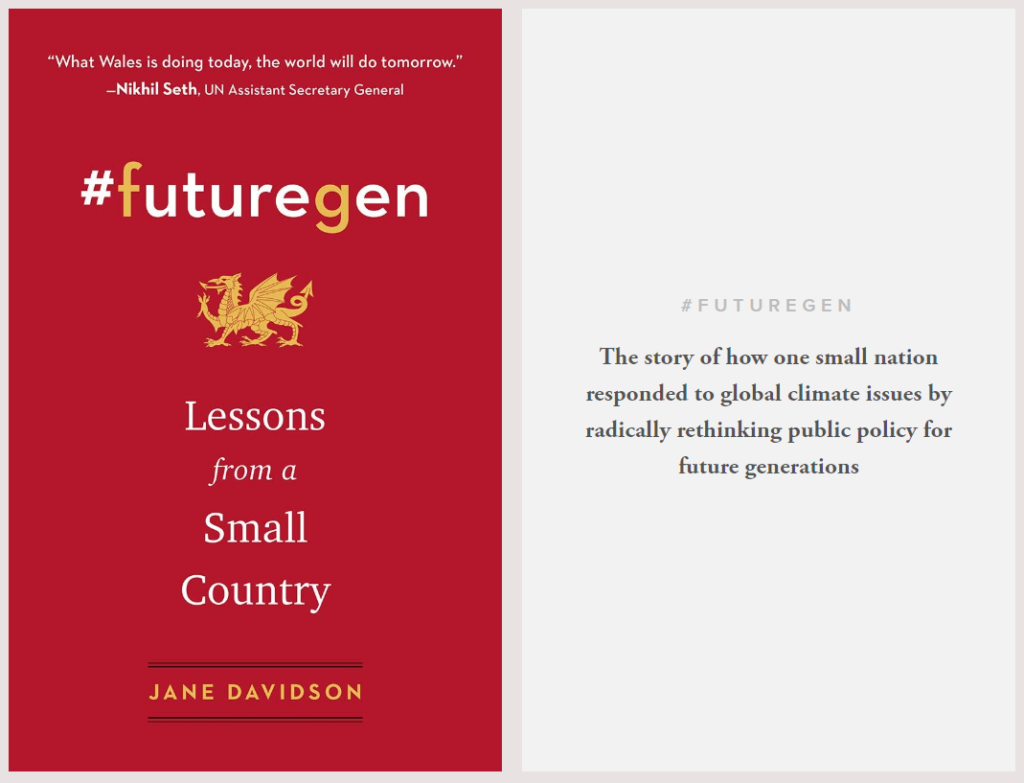
Jane Davidson was the Welsh Government Minister for Environment, Sustainability and Housing who first proposed what became the Well-being of Future Generations (Wales) Act 2015. For a comprehensive account of the introduction of what has been described as “the first piece of legislation in history to place regenerative and sustainable practice at the heart of government” you can read Jane Davidson’s book entitled “#futuregen“.

Part of the significance of the Act for resource and waste management is the Act’s promotion of long-term thinking capable of disrupting the tendency to put the demands of electoral cycles ahead of what is required for sustainability.

Such a profound cultural shift is highlighted by Jane Davidson, including in the following passage from page 111 of her book:

The addition of ‘culture’ to the usual three domains (environment, society and economy) is an important contribution that I would recommend to any country deciding to go down this route and one that we first added into ‘One Wales, One Planet’. This is because I believed then and now that changing ‘culture’ (including…organisational culture) is the most powerful tool to create the marriage between evidence and empathy needed to enable the delivery of a future generations framework…It is critically important in particular that the Act is not seen to be in the ‘culture’ of any one political party but is a tool for the people of Wales to hold their government and public services to account by calling for a change to the current consumerist, wasteful, throw-away society.

Support for collaborative change

Decisions were made to support these policies with the guidance and funding necessary to achieve the various goals, targets, and commitments described above. Instead of leaving matters to the vagaries of ‘market forces’, organisations such as WRAP Cymru are actively involved in promoting systemic change.

Under the heading “Tackling the entire system” WRAP Cymru explains how: “Tackling a single part of an issue can just move the problem elsewhere. We take a holistic approach, consider the whole system and create solutions that work together”.

A practical example of this systemic approach is WRAP Cymru’s Market Development Programme, which is designed “to increase both the supply of, and demand for, products containing recycled content in Wales”, though supporting the use of recycled material in manufacturing via a Circular Economy Fund and a range of supply chain projects offering technical support. WRAP Cymru is also working with the public sector to increase the procurement of sustainable goods.

At the heart of these efforts is WRAP Cymru’s Collaborative Change Programme (CCP), which offers “strategic, technical and communications support to help local authorities develop and deliver detailed plans to achieve the outcomes of Welsh Government’s national waste strategy, Beyond recycling”. And at the heart of the CCP is Russell Owens, who has been described as “The unsung hero of Wales’ recycling success!”

Wales remains ahead of the pack

In April 2017 the House of Commons Environment, Food and Rural Affairs Committee (EFRACOM) published a report on Food waste in England.

The EFRACOM report recommended “that there should be a national food waste target. An ambitious, formal target on food waste would influence the Government’s approach to food waste, ensuring that there continues to be a focus on reducing food waste“.

The report included the following graph which acknowledges how the devolved nations provided a higher proportion of households with food waste collections, with Wales having exceeded 90% by 2012. This figure grew to 99% by March 2020.

Indeed, according to official UK waste statistics, Wales has remained ahead of the pack for more than a decade.

As can be seen from the chart and image below, most Welsh Local Authorities continued to improve their recycling rates throughout 2022 and into 2023, reaching around 66% recycling.

Going beyond recycling – making it real

For more than two decades Wales continued to make progress with recycling and composting, and with diverting waste from both landfill and incineration. These efforts were celebrated with the publication in March 2021 of ‘Beyond Recycling’ the Circular Economy Strategy for Wales.

Described as “A strategy to make the circular economy in Wales a reality”, the publication was accompanied by the release of a 7-page ‘Easy read version’ which includes the following:

The publication of Beyond Recycling was also accompanied by “an immediate moratorium [halt] on any future large scale energy from waste [incinerator] developments”. 

As Lesley Griffiths explains in her Minister for Environment, Energy and Rural Affairs’ 24th March 2021 Written Statement ‘Taking action to make the circular economy a reality’:

…this moratorium…recognises the views we received from citizens and stakeholders during the consultation on Beyond Recycling and the advice from the UK Committee on Climate Change on the pathway needed for Wales to decarbonise. This will be accompanied by the publishing of an updated strategic assessment which shows…the success of our recycling and the decrease in waste generated in Wales means no further large scale energy from waste plants [i.e. those capable of generating 10MW or greater] are required.

The Written Statement goes on to specify that: “Any new small scale [incineration] facilities must also supply heat, and where feasible, be carbon capture and storage enabled or ready. This will therefore mean a small scale plant would not be allowable if waste is to be imported from outside of the proposed region…in order to also avoid locking in transport emissions and associated pollution. This moratorium is being given effect through the planning system. Planning Policy Wales states that the extent to which a proposal demonstrates a contribution to waste management objectives, policy, targets and assessments contained in national waste policy will be a material consideration”.

And on page 26 of the full Beyond Recycling strategy document we read how:

In order to go beyond recycling, we want to develop the infrastructure to accelerate the growth in re-use, repair and remanufacturing and support an expansion in hiring, leasing and lending. We will also need to ensure the infrastructure we have is decarbonised and future investment supports the wider transition to a low carbon economy. We will work with key partners as part of our Team Wales approach to achieving a net zero public sector by 2030.

“As repair, re-use and recycling continue to expand, we want to ensure the capacity we have for generating energy from waste is in line with the capacity needed during our transition to a circular economy, with the long-term solution being to move away from incineration. We also want to see our towns across Wales demonstrate circular approaches by having repair and re-use hubs as well as other important infrastructure including refill points, zero waste shops and resilient green infrastructure.

Wales’ role as trailblazer and exemplar is confirmed by the actions of the Scottish Government, who followed suit with their own incinerator moratorium in 2022 following a temporary pause announced in November 2021.

And in breaking news, following extensive lobbying by members of communities across England, the UK Government appears to be taking some steps that could result in a moratorium on new waste incineration capacity in England, as all environmental permits for new incinerators have been put on hold as of 4th April 2024 to, in Sir Mark Spencer’s words: “…allow a short period for Defra officials to lead a piece of work considering the role of waste incineration in the management of residual wastes in England”, impacting on dozens of incinerators with a cumulative total of millions of tonnes of capacity, including those that have secured planning permission but that have yet to secure an environmental permit.

As has been acknowledged many times by many people involved with Wales’s journey towards zero waste and a more circular economy, the community has been central to the Welsh circular success story. It is demonstrably true that community-based organisations and groups of circular citizens were pivotal when it came to bringing about, and ensuring the enforcement of, the moratorium on new waste incineration capacity in Wales.

Beyond this pair of blog posts, the Circularity Foundation will be identifying and exploring a range of ‘success factors’, such as community involvement, systems thinking, an emphasis on the quality of recyclates, and the provision of policy support including Government financing associated with “How Wales became a world leader in recycling”.

New: The Circularity Foundation publication considering the success factors contributing to Wales’s circular success story – Circular citizenship in Wales – is now available to download.

The power of circular citizenship in Wales (Part 1)

This telling of the story of circular citizenship in Wales – which comes in two parts – begins in the late 1970’s and runs through the 1999 devolution of responsibility for waste management to the Welsh Assembly Government and the June 2002 publication of the first national waste strategy for Wales. Part 2 will pick up the thread from 2005 continuing up to the publication of ‘Beyond Recycling’ the Circular Economy Strategy for Wales in March 2021.

In the beginning…

Whilst resources, including discarded resources (i.e. waste), have of course been managed for many, many years, this origin story takes as its point of departure the establishment of the Community Support Anti-Waste Scheme – or CSAWS – which operated in Cardiff from around 1979 – 1989. CSAWS is credited as being the UK’s first citywide kerbside paper collection scheme for recycling.

Another pioneering initiative – this one based in Bristol – was known as ‘Resourcesaver’. Described as a ‘direct collection project’, Resourcesaver was managed by Dick Perry and Jane Stephenson and associated with Bristol / Avon Friends of the Earth. According to an April 1987 feasibility study carried out by David Mansell:

Having discussed the origins of the commitment to zero waste in Wales with Mal Williams, the Executive Director of The Zero Waste International Trust, it became clear that Mike Croxford was one of the pioneering circular citizens behind the Welsh story. Both Mal and Mike are described as having been “instrumental in driving source separation and the collection of high quality recycled materials in Wales” over the past 30 years.

Mike Croxford has been described as “a pioneer of recycling in his native Wales…[whose] interest in recycling began in 1980, while running the Augusta Street youth project in Cardiff. The young people started collecting newspapers to improve their standing among local people and to fundraise to run events for the community. The project turned into the Community Support Anti-Waste Scheme (CSAWS) that in 1986 initiated the first citywide collection scheme in the UK”.

Although there are no signs of a CSAWS website anywhere on the Internet, CSAWS is listed as having received £7,489 of funding from the Welsh Office’s 1978/79 Urban Programme, and as having been sponsored by Cardiff City Council. CSAWS was described in a doctoral thesis (entitled Waste Paper Recycling A Community Technology Approach) as an “Anti-Waste Co-operative” that employed eight people in 1981.

CSAWS is listed as an Affiliate Member of the Wales Council for Voluntary Action (WCVA) in the WCVA Annual Reports for 1986/87 and 1987/88, and reference was made to CSAWS in House of Lords as part of a debate on the re-use of waste materials that took place on 13th November 1989. Lord Hooson explained how “One hundred local businesses were involved, the local authority was involved and there was an urban aid grant from central government. Recycling took place with eventually a full-time staff of 47. There was a great deal of voluntary collection, and the activity was particularly directed at paper recovery” adding: “That shows what can be done in one town”.

Newport is another town in South Wales where the community has been active in promoting recycling since the 1980’s. According to their website, Wastesavers is both a social enterprise and a charity that currently offers “commercial recycling services in Newport, Cardiff, Monmouthshire, Torfaen and surrounding South Wales areas”. As a social enterprise Wastesavers “provides the weekly domestic recycling service for 75,000 households on behalf of Newport City Council”. The Wastesavers Charitable Trust (Charity No: 1116150), which benefits from the support of more than 120 volunteers as well as more than 40 employees, runs a network of reuse shops, two repair cafes, a Nappy Library and two education programmes.

One of these education programmes, known as ‘PEAK’, entails delivering an “alternative curriculum for young people struggling with mainstream education”. According to their 2023 Trustees Report, Wastesavers Charitable Trust “works with schools, pupil referral units, the youth offending team, social services, and local authorities in South East Wales, specifically Newport and Torfaen, to take young people who are finding it difficult in mainstream education. The young people then work towards gaining basic/essential skills including plumbing, carpentry, bike repair, cookery, photography and Art and Design”.

Wastesavers was set up in 1985 to promote the importance of reuse and recycling in Newport, with an emphasis on maintaining recyclate quality and engaging the local community. Their website describes how, in the mid 1990’s they “became more proactive and began picking up old newspapers from peoples’ doorsteps for recycling, and hand sorting these at the local paper mill”. The About section shares how: “In 1995 Wastesavers collected and recycled 22 tonnes of paper. Today Wastesavers recycles more than 18,000 tonnes of material…We now employ more than 100 people across our kerbside and commercial operations as well as our reuse and education charity work”.

For more about The Story of Newport, and how “when separate collection systems prioritise quality over just quantity, and invest heavily in meaningfully engaging with the community, combined with well-designed equipment, world-leading results can be achieved whilst simultaneously reducing costs for local residents” see the case study produced by Zero Waste Europe as part of their Zero Waste Cities initiative.

Another major breakthrough for Wales was the establishment in 1997 of Cylch (Welsh for ‘circle’), the Wales Community Recycling Network (Wales CRN), which was formed to promote sustainable resource management through education and practical action in Wales.

As their Wiser Directory entry explains, from the very beginning Cylch promoted and supported “partnership-led, community-based, sustainable resource management initiatives as the practical and effective solutions to Welsh waste problems”, whilst viewing so-called ‘waste’ materials “as valuable resources, which, if managed effectively, create environmental, social and economic benefits for individuals and the communities in which they live”.

Their website was launched in February 1999 where Cylch is described as “a non-profit-distributing, registered charity, forming the Welsh element of the Community Recycling Network UK (CRNUK)” with the following aims and objectives:

  • to promote sustainable resource management through public education and practical action
  • to position the community sector centrally as an equal partner in the future of resource management in Wales
  • to ensure free exchange of information between member organisations
  • to support new and existing waste minimisation, re-use, recycling and composting projects, enabling them to achieve financial independence through delivering high quality support services to them

Significantly, with respect to their aim of positioning the community sector centrally as an equal partner in the future of resource management in Wales, Cylch’s Chief Executive Mal Williams was appointed the community sector representative on the Wales Waste Forum. The Wales Waste Forum was established in December 2000 by the Welsh Government Minister for Environment, Transport and Planning Sue Essex to advise on the development of the Welsh waste strategy.

Such a national waste strategy for Wales was required because in 1999 responsibility for waste management was devolved to the Welsh Government.

1999 – All change

1999 was a transformative year, both for waste management and for Wales.

The Landfill Directive, more formally described as Council Directive 1999/31/EC of 26th April 1999, was a European Union directive for the regulation of waste management in landfill sites across the European Union. The Directive’s overall aim was “to prevent or reduce as far as possible negative effects on the environment, in particular the pollution of surface water, groundwater, soil and air, and on the global environment, including the greenhouse effect, as well as any resulting risk to human health, from the landfilling of waste, during the whole life-cycle of the landfill”. This legislation had important implications for the management and disposal of waste.

Less than a month later the National Assembly for Wales met for the first time (on 12th May 1999), when the Welsh Government was given a statutory duty to promote sustainable development. This proved to be a turning point for waste and resource management in Wales.

In a press release, entitled ‘How Wales became a world leader in recycling’, issued by the Welsh Government in March 2020, we read how: “The Welsh Government is working to make Wales a greener, more equal, and more prosperous country. How we manage our waste and the resources we use has become even more crucial; in the growing fight to tackle climate change. Since Wales has had its own government in 1999, we have become a global leader in recycling. We’re now first in the UK, second in Europe and third in the world for household waste recycling. Put simply, recycling is what we do! This achievement has taken a clear, long term vision, strong partnership working, significant investment and clear milestones along the way”.

1999 also saw the publication in July of a visionary book by Robin Murray entitled ‘Creating wealth from waste’. Both the book and Robin Murray’s own active involvement proved inspirational to the UK’s emerging zero waste movement. Robin had already been working with others, including Nicky Gavron who was made Deputy Mayor of London in 2000, on an alternative Alternative Waste Strategy for London which had been published as ‘Re-Inventing Waste: Towards a London Waste Strategy’ in August 1998. Robin went on to write ‘Zero Waste’ which was published by the Greenpeace Environmental Trust in February 2002.

In ‘Creating wealth from waste’ Robin Murray set out how waste management was becoming “a dynamic, fast-changing, international economic sector” and how “This transformation presents new choices and opportunities, and provides lessons and pointers for industrial, social and environmental policy” driven by growing concern about the hazards of waste disposal, broader environmental concerns, especially global warming and resource depletion, alongside “the economic opportunities created by new waste regulations [such as the Landfill Directive] and technological innovation”.

Prophetically, Robin warned how: “…Multinationals are taking an increasing interest in waste. Privatisation has opened up new markets in collection. The new standards of treatment and the industrialisation of waste management require resources beyond the means of small and medium-sized firms…the environmental movement has created a new economic interest in waste and recycling. This interest, combined with the opportunities created by technological innovation, is extending down through the supply chain” noting that: “Intensive recycling and waste reduction depends on changing whole systems. It relies on distributed intelligence rather than centralised knowledge and on innovation that is widely dispersed across collection, processing, materials technology and product design. As a result, the change can seem far harder to achieve than the straightforward modernisation of existing systems”.

“Zero waste” is one term used to describe the profound systemic change required to meet the combined challenges posed by the increasing commercialisation (or ‘industrialisation’) of waste management (previously led by the public sector) and the environmental imperatives of addressing climate change and resource depletion.

The zero waste community leads the way

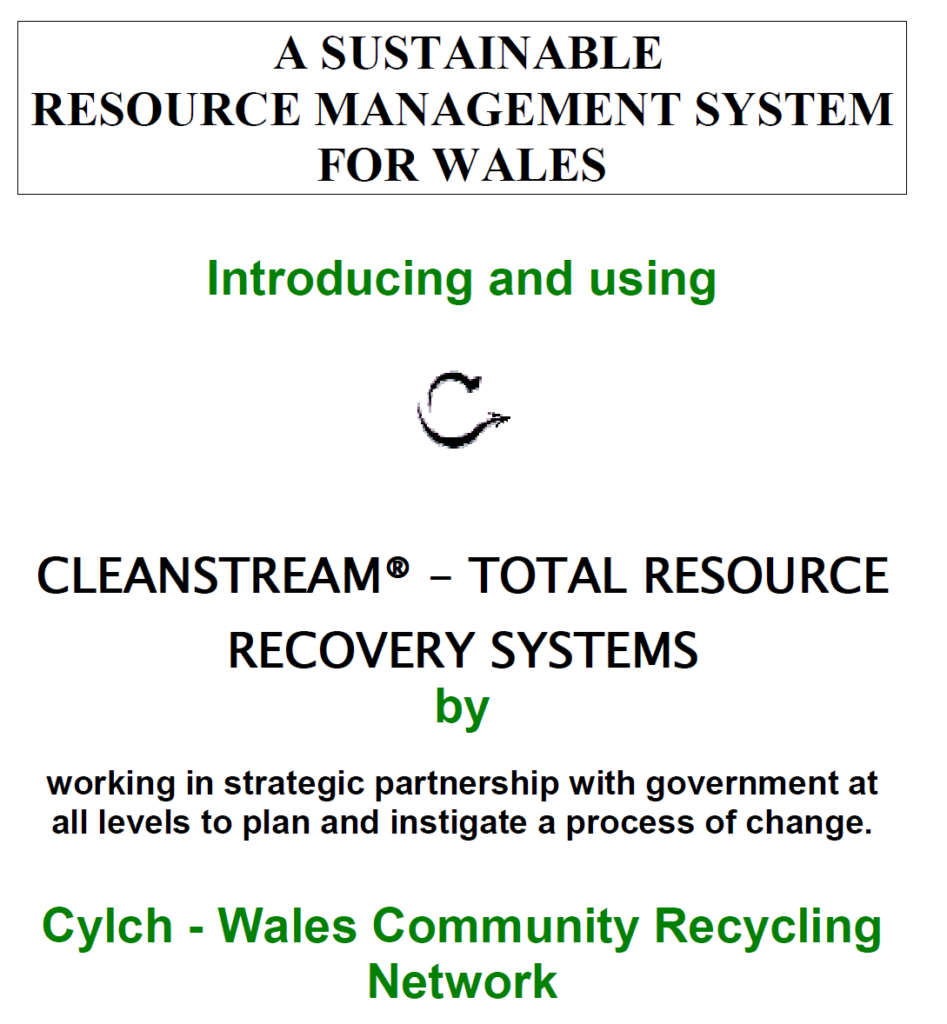
Cylch’s dedication to promoting “sustainable resource management through public education and practical action” found practical expression in the approach to “Total Resource Recovery” known as Cleanstream® which was first introduced in March 2000. This constituted a profound community contribution to the emerging national waste strategy for Wales.

In Cylch’s own words: “Cylch’s Community Waste Strategy is based on working in partnership with government at a national, regional and local level to achieve a Sustainable Resource Management Strategy and Implementation Plan that will reduce waste. To meet and exceed the targets set by the current legislation in the Landfill Directive and the forthcoming UK Waste Strategy. Cleanstream® is a quality standard but this document incorporates it into a PROCESS of managing change”.

Cylch declared that “if we separate used materials in the first place, we have an opportunity”. Described as “the vehicle that creates and develops this opportunity”  Cleanstream® was designed to set a standard and describe a process “to achieve radical change in the way we manage resources after first use” intended to show how Wales could “utilise its new found political independence and Objective 1 status in order to reap the tremendous benefits of changing to this very Sustainable Resource Management System“.

The thinking that underpinned the Cleanstream® Total Resource Recovery System proposed for Wales also influenced zero waste activists around the world. In 2002 what became known as The First Zero Waste Dialog was held in Brighton. According to the Zero Waste International Alliance (ZWIA), in February 2002 “activists, most of them part of the ZWIA team as well as experts from several other organizations, held a meeting chaired by Professor Robin Murray, teacher at the London School of Economics and author of two books on Zero Waste (Zero Waste and Creating Wealth From Waste). Together the team helped to form a Zero Waste coalition for the UK, and also set the wheels in motion for formation of the Zero Waste International Alliance (ZWIA). This meeting was what the ZWIA team later retrospectively called the first Zero Waste dialog”.

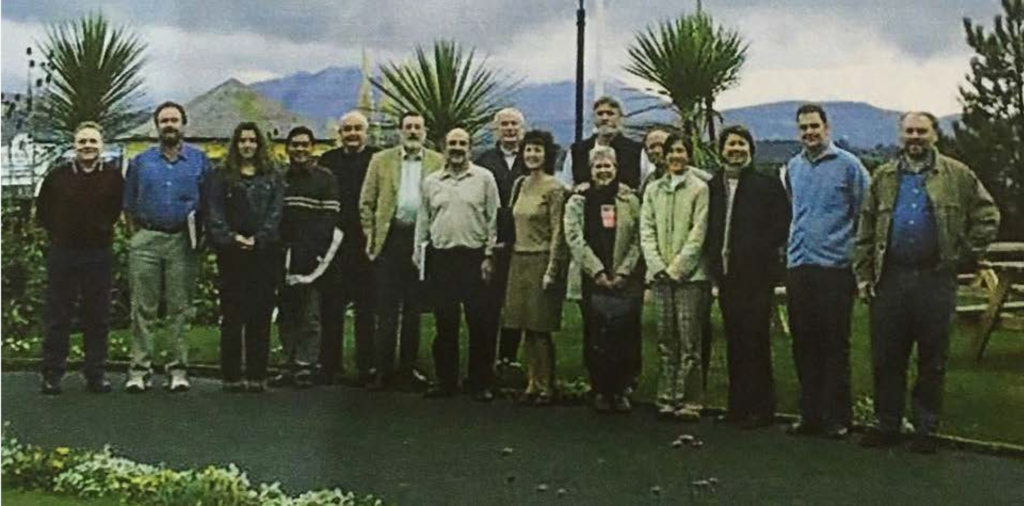
Photograph of Zero Waste International Alliance’s inaugural meeting,
which took place in Wales in October 2003
Thanks to Mal Williams for providing a copy of this photograph
From left to right: Warren Snow (Zero Waste New Zealand Trust), Eric Lombardi (Eco-Cycle), Monica Wilson (GAIA), Manny Calonzo (GAIA, The EcoWaste Coalition), Mal Williams (Cylch), Richard (Ric) Anthony (Grass Roots Recycling Association), Mike Underwood (Cylch and Biognosis), Robert Slater (Environment Canada), Julie Dickinson (Zero Waste New Zealand Trust), Gerry Gillespie (Zero Waste Australia), Carolyn Brooks (Zero Waste Australia), George Cheng (Waste Not Asia), Chia-Jung Lee (Taiwan Watch Institute), Sonia Mendoza (Mother Earth Foundation), Jim McLaughlin (Community Resource Network), and Andy Moore (Community Resource Network)

Those wheels continued to turn, and from 19th – 21st October 2003 a series of meetings were held at the Bulkeley Hotel in Beaumaris, Ynys Môn, Wales resulting in the formation of the Zero Waste International Alliance with the following initial focus:

  • To convert waste to resources for the benefits of local production and the creation of a sustainable society.
  • To redesign products and methods of production to eliminate waste by mimicking natural processes and close loops.
  • To resist incineration and landfilling in order to promote innovation in resource conservation and methods of production.
  • To collaborate with others with common interests worldwide, to advance the education of the public by all appropriate means through the elimination of waste.
  • To promote and fund scientific research for the public benefit.
  • To promote the effectiveness of other (zero waste) charities.
  • To promote recycling through sustainable resource management in accordance with best practice.

These meetings were informed and energised by the paradigm-shifting genius that inspired the Cleanstream® approach, and the whole event was funded using earnings from Cylch’s work supporting the development of a zero waste strategy for Doncaster.

According to ‘An opportunity not to be wasted: Doncaster Waste Strategy 2009’: “The [Doncaster] Mayor’s Zero Waste Strategy was developed by DMBC [Doncaster Metropolitan Borough Council] in 2004; the process involved a significant amount of public consultation and engagement with different stakeholder groups. The approach was significantly wider than just municipal waste and aimed at combining resource efficiency actions with those for economic development and employment in Doncaster”.

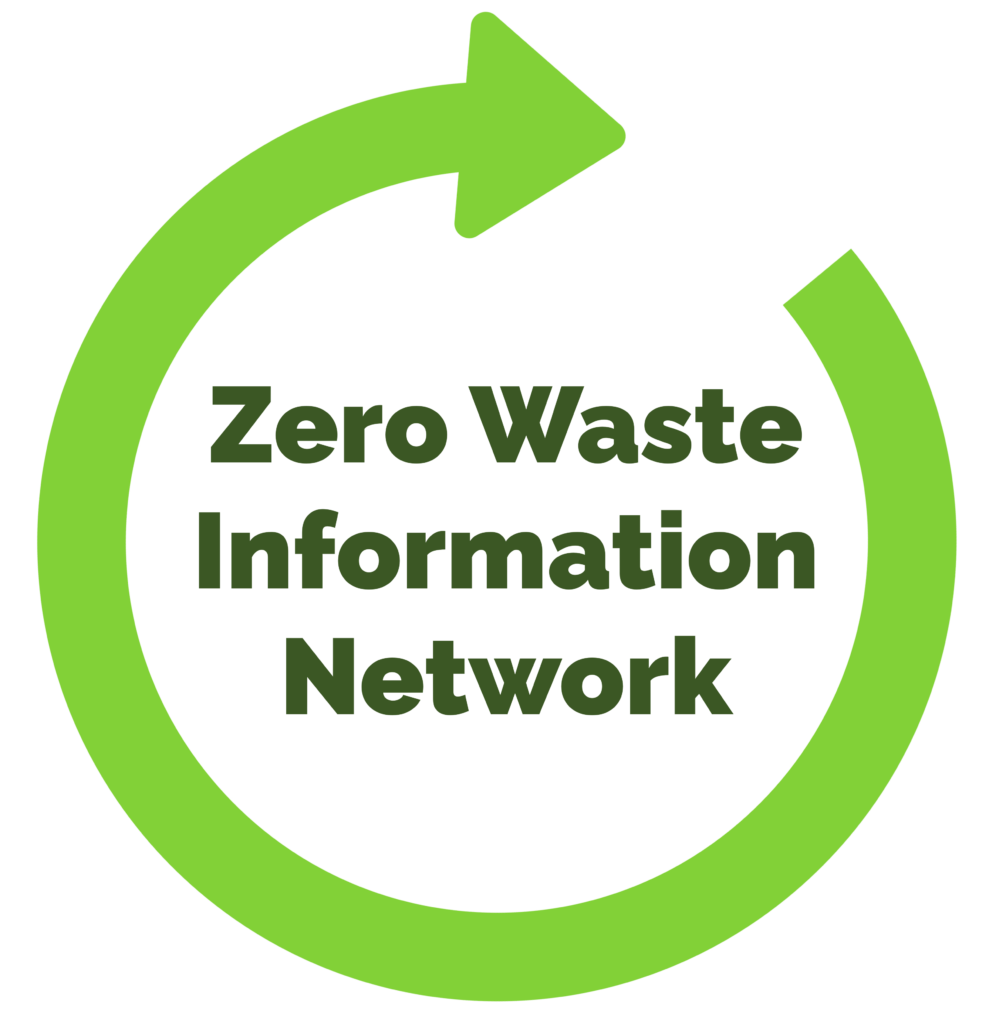
Returning to Wales, and returning to June 2002, the first national waste strategy for Wales was published. ‘Wise About Waste’ opened with the following paragraph: “Waste is Wales’ biggest environmental problem; a problem to which we all contribute as individuals on a daily basis. However we can also as individuals be part of the solution. This new waste strategy for Wales, Wise about Waste, sets the direction for developing sustainable waste management practices in Wales, in some cases building on the good work that is already taking place and in others developing whole new solutions. This new strategy replaces the joint England and Wales Waste Strategy 2000 and represents the National Assembly for Wales and the Welsh Assembly Government taking formal responsibility for waste matters within Wales“.

Wise about Waste went on (at paragraph 5.39) to spell out how: “Local authorities are encouraged to enter into partnerships with the community sector and the waste industry to deliver an integrated system that maximises the separate kerbside collection of recyclable and compostable material and the further extraction of materials from residual wastes. This three-way partnership can take maximum advantage of the strengths of each sector. In particular, local authorities are encouraged strongly to involve the community recycling sector, since it:

  • has a proven track record for kerbside collection schemes for recyclables;
  • can make an important contribution towards re-use (e.g. of furniture) which counts towards the Best Value Performance Indicator for recycling;
  • can provide support for disadvantaged people (thus maximising the wider social benefits of the strategy);
  • is able to energise and engage communities;
  • is likely to increase motivation of householders to participate in kerbside collection schemes if they perceive that charitable causes are benefiting;
  • has a proven track record for community composting of green wastes;
  • has a proven track record for education initiatives”.

And in the following paragraphs the strategy is even more explicit and focussed in the recommendations and offers of support, stating that: “Local authorities are strongly encouraged to follow the principles of the Cleanstream® approach advocated by the Wales Community Recycling Network/Cylch. This sets a standard for a ‘total resource recovery system’ that maximises the collection of clean recyclable and compostable materials from the household waste stream” and announcing how: “The New Opportunities Fund is committing, by 2004, £3.25m to projects that expand community sector waste, re-use, recycling and composting…”

Wise about Waste was many things, including: the first waste strategy for Wales; an expression of the National Assembly for Wales and the Welsh Assembly Government taking formal responsibility for waste matters within Wales; a pitch to  individuals to be “part of the solution”; a set of recycling targets to which Wales’ various local authorities were expected to work; and a radical shift away from ‘waste management’ and towards ‘resource management’. Importantly in the context of this exploration, Wise about Waste was a very public, ‘high profile’, affirmation of how the zero waste community led the way in establishing principles that made their way to the core of the approach to be applied across the nation of Wales!

As you can see, when it comes to circular citizenship in Wales, there is much to celebrate and plenty to learn. Pioneering community-led initiatives coupled with respectful recognition and collaborative efforts on the part of local and national government in Wales has the power to inspire and to inform.

This first half of the story provides essential background information that – together with Part 2 – will help us appreciate both the community’s formative contribution to a more circular Wales, and Wales’s ongoing contribution to global efforts to improve recycling rates and move beyond recycling to a more circular, zero waste, economy.

Frugal Doughnut Sufficiency

No, not a new year’s resolution about being satisfied reducing the number of doughnuts I consume in 2024. More of a post-holiday treat that brings together some of what I have been reading (and re-reading) about Doughnut Economics, sufficiency, and frugal value.

Establishing conceptual underpinnings for the Circularity Foundation has introduced me to several interesting authors, including Carina Millstone (who wrote Frugal Value: Designing Business for a Crowded Planet), Nancy Bocken (co-author of several articles about the circular economy, e.g. The Sufficiency-Based Circular Economy: An Analysis of 150 Companies), and now Kate Raworth.

Brief descriptions of a range of circular concepts can be found on the Circularity Foundation’s https://www.circularityfoundation.org.uk/concepts/ webpage.

Enter the Doughnut

The following excerpts from Kate Raworth’s instant classic Doughnut Economics: Seven Ways to Think Like a 21st-Century Economist are shared with the intention of encouraging you to read the whole book to benefit from Kate’s fuller critique of traditional economics (what Carina describes as the ‘legacy economy’) and from the context Kate provides for understanding and appreciating the circular economy’s potential (and limitations).

A critique coupled with a mission (from page 25):

“For over 70 years economics has been fixated on GDP, or national output, as its primary measure of progress. That fixation has been used to justify extreme inequalities of income and wealth coupled with unprecedented destruction of the living world. For the twenty-first century a far bigger goal is needed: meeting the human rights of every person within the means of our life-giving planet.”

A reference to the circular economy (from page 29):

“This century needs economic thinking that unleashes regenerative design in order to create a circular—not linear—economy and to restore humans as full participants in Earth’s cyclical processes of life.”

Kate’s rallying call for systemic change (from page 156):

“Today’s economy is divisive and degenerative by default. Tomorrow’s economy must be distributive and regenerative by design. An economy that is distributive by design is one whose dynamics tend to disperse and circulate value as it is created, rather than concentrating it in ever-fewer hands. An economy that is regenerative by design is one in which people become full participants in regenerating Earth’s life-giving cycles so that we thrive within planetary boundaries.”

Observations about the shortcomings of a ‘business-as-usual’ approach to the circular economy (from pages 222-229):

“…the notion of a truly circular economy belongs with the fantasy of perpetual motion machines: a more accurate name would be the cyclical economy. No industrial loop can recapture and reuse 100% of its materials…Corporate interest in forging ‘circular advantage’ is growing fast, and companies leading the pack have adopted a niche set of circular economy techniques such as: aiming for zero-waste manufacturing; selling services instead of products (like computer printing services instead of printers); and recovering their own-brand goods – ranging from tractors to laptops – for refurbishment and resale. These are excellent strategies for efficient resource reuse and they can be highly profitable too…The trouble is, they just do not go far enough, and there is a clear reason why. Shaped to fit in with existing corporate interests, circular economy strategies to date have typically been: top down, driven by large corporations; in-house, with companies seeking to establish control over their used products; opaque, thanks to patented materials and proprietary technologies; and fragmented into disconnected parts, within and across industries. That is by no means a strong foundation for building a regenerative, let alone distributive, industrial ecosystem…Regenerative industrial design can only be fully realised if it is underpinned by regenerative economic design.”

As these excerpts show, Kate is an advocate for an ‘open source’, regenerative and redistributive circular – or ‘cyclical’ – economy. She recognises the shortcomings and limitations associated with attempts to establish a more circular economy that challenges the ‘business as usual’ economic model that devalues the environment whilst ignoring the urgent need for greater fairness for all human beings.

Enough already!

Might the notion of ‘sufficiency’ have something to offer in this respect? Nancy Bocken and her colleagues certainly seem to think so.

As Nancy Bocken, Laura Niessen and Samuel W. Short wrote in The Sufficiency-Based Circular Economy: An Analysis of 150 Companies an ‘open access’ article published by Frontiers in Sustainability in May 2022:

“…the concept of ‘sufficiency’ is inadequately represented in the current circular economy discourse and innovations, and this may be undermining real progress…In this article, we position sufficiency as the missing link in the Circular Economy transition and discourse. The increasing pressure of human activity on the climate and biodiversity, and the limited potential for circular economy to address the endless growth in demand for materials and energy, require a refocus on a sufficiency-based circular economy, where consumption avoidance is prioritized over strategies such as recycling”.

The study’s authors cite a 2021 article by Anne Velenturf et al (entitled ‘Rethinking Economic Theory and Practice for a Sustainable Circular Economy’) stating:

“Circular economy may well be at an important crossroad: it can continue to propose incremental changes to resource flows, leaving the wider, unsustainable, economic system unchanged, or it can join a transformative movement toward a sustainable circular society”.

Under the sub-heading “Sufficiency in the Wider Circular Economy Transition” Nancy and her colleagues make the point that:

“The Circular Economy has been presented as a future paradigm effectively combining resource savings and economic growth. However, critics have argued that meeting human needs while minimizing environmental impact would be a better goal than achieving material circularity (Allwood, 2014; Zink and Geyer, 2017). In response to this critique, recent work by Bocken and Short (2021) introduced a framework to position the circular economy in relation to broader perspectives on a sustainable society (Figure 2)”.

“…As shown in Figure 2, a Sufficiency-based Circular Economy is also not the last step in business transformation toward real sustainability. For a sustainable future, business practices will need to be regenerative and contribute positively to society and the environment, leaving the environment (and society) in a better state than before, to undo the environmental degradation of the past century (Hahn and Tampe, 2021)…In practice, this means introducing policy and regulation that shift economic growth and wealth accumulation objectives toward delivering a thriving environment and society, and redefine the parameters under which business operates, rather than simply leaving it to deregulated ‘market forces’ to deliver the needed change. While the circular economy has put us on a different pathway to innovation beyond efficiencies and cost-savings, and will be a core part of any future sustainable system, this perspective is inadequate on its own to have a radical impact on environmental issues, when interpreted in a narrow way.”

This clearly resonates with both Kate and Carina’s calls to action.

Efficiency + Sufficiency = Frugality

In Frugal Value, Carina describes the shift from ‘legacy’ to ‘frugal’ products as requiring both resource-efficient (‘resource-sparing’, ‘nature-inspired’, and ‘user-centred’) and resource-sufficient (‘long-lived’, and ‘shareable’) products, i.e. products “that use minimal amount of resource per unit, and contribute to resource use reduction overall (as well as minimising the impacts on sinks and regulation associated with resource use)”.

As Carina explains (from page 56):

“Shareable products reduce the need for duplicate objects now; long-lived objects reduce the need for duplicates over time.”

System-level changes for the better

Kate’s call is succinctly explained at https://www.kateraworth.com/doughnut/

“Humanity’s 21st century challenge is to meet the needs of all within the means of the planet. In other words, to ensure that no one falls short on life’s essentials (from food and housing to healthcare and political voice), while ensuring that collectively we do not overshoot our pressure on Earth’s life-supporting systems, on which we fundamentally depend – such as a stable climate, fertile soils, and a protective ozone layer. The Doughnut of social and planetary boundaries is a playfully serious approach to framing that challenge, and it acts as a compass for human progress this century.”

Carina concludes her book by pointing to three key system-level changes needed to make frugal value (i.e. combining efficiency and sufficiency) possible:

  1. Move away from an economy of distance to an economy of proximity (“…companies must cease to be itinerant, following cost-saving opportunities, and must instead become anchored in their locality”).
  2. Move away from a growth-reliant economy dominated by one form of organisation, the external shareholder-owned for-profit company, to a plural economy, where multiple organisational forms co-exist, flourish and support degrowth.
  3. Change how resources are used in economic activity, and how their associated planetary impacts are determined, allocated, and valued.

Where does this leave us?

Something I draw from this discourse is that whilst greater efficiency and indeed a more circular economy are to be welcomed, they are not enough to bring us to the sweet spot of the Doughnut where all people’s needs are met without exceeding planetary boundaries. While greater sufficiency would help, ‘market forces’ cannot be trusted to deliver the desired outcomes.

As Nancy and her colleagues put it, there is an urgent need for policies and regulations “that shift economic growth and wealth accumulation objectives toward delivering a thriving environment and society, and redefine the parameters under which business operates, rather than simply leaving it to deregulated ‘market forces’ to deliver the needed change”.

This comes across as a vital message to bring with us into 2024, alongside a hope that the forthcoming UK general election might result in greater support for the sorts of policies and regulations that can help bring about a ‘flourishing’ that puts ‘societal and environmental well-being above profit’ (as per Figure 2, above), allowing the great potential of the circular economy to be fulfilled.

Circular Economy Change Conversation

The Circularity Foundation is currently undertaking a research project exploring what is changing in the world of resources and waste management and how people feel about these changes.

An important aspect of our research involves listening to people who are interested in the circular economy. We are holding a series of conversations to help us understand differing perspectives on the changes taking place within the resources and waste sector and on how these changes are supporting and/or creating barriers to the transition to a more circular economy.

The starting point for participants is to respond to the following questions:

  • What changes do you see currently taking place in the Resources and Waste sector, and how do you feel about these changes?
  • How do you see these changes supporting and/or creating barriers to a more circular economy?

Responses to these questions will be analysed, and we will feed our learning back to those who contribute.

The Circular Economy Change Conversation project is intended to develop in line with the following timetable:

  • Initial round of approaches to potential participants (August / September 2022)
  • Launch of website option (by September 2022)
  • Initial round of ‘interviews’ (September 2022 – February 2023)
  • Closure of the website option (February 2023)
  • Analysis and feedback / Interim Report (February 2023 – June 2023)
  • Change conversation roundtable discussions (September 2023 – December 2023)
  • Analysis and feedback / Final Report (November 2023 – March 2024)
  • Dissemination of learning and formulation of next steps (March – August 2024)

You may wish to take part in this research project in any of the following ways:

Introducing the Circularity Foundation

Hello. My name is Shlomo Dowen, and I am one of the many people who contributed to the creation of the Circularity Foundation.

When we first set out to establish a charity dedicated to prudent resource use we were focussed on ‘zero waste’. As we began to develop our ideas for the charity we became increasingly aware of the emergence of the ‘circular economy’.

It soon became obvious that our charity would be dedicated to advancing education about the circular economy in ways that included, but were not limited to, the notion of zero waste.

It is also the case that, in the years while the Circularity Foundation was being developed, the circular economy concept quickly moved from relative obscurity to become a much-talked-about ‘hot topic’.

The circular economy, as an alternative to the linear ‘take-make-destroy’ economy, is now much more widely recognised than when we first applied for charitable status in 2018. Even then, the circular economy had already been the focus of a European Commission led public consultation (held in 2015) that gave rise to a package of legislative proposals (that became known as the Circular Economy Package) and associated strategic plans.

At that time, the circular economy was anchored in the resources and waste sector. Back then it was still a fairly specialist topic that attracted the interest of a narrow collection of waste geeks, building on earlier notions of a ‘recycling society’.

Over the past few years interest in the circular economy has grown to encompass a very wide range of people and organisations including, but by no means limited to:

  • environmentalists (including climate activists and other environmentally active citizens, such as anti-incineration campaigners);
  • zero waste lifestylers (including those seeking to reduce the wasteful use of plastic in society by starting with their own personal choices);
  • those involved in resource management (including waste trade press journalists, academics, and environmental consultants, as well as those engaged in reuse, recycling, composting, reprocessing, etc.);
  • multi-national corporations (including those mindful of their public image and keen to be seen as acting responsibly in the face of public concerns); and
  • pioneering circular economy organisations (including social enterprises and not-for-profits, such as those dedicated to reducing food waste).

With all this expansion in the number of people and organisations involved in the circular economy, what unique role can be fulfilled by the Circularity Foundation?

We at the Circularity Foundation are thrilled by this rapid expansion, and we are well aware that keeping pace with the development of circular economies is a genuine challenge. To help meet this challenge, the Circularity Foundation intends to host a series of ‘change conversations’.

These conversations will draw out multiple perspectives on the changes taking place within the resources and waste sector and on how these changes are supporting and/or creating barriers to the transition to a more circular economy.

Using a range of systems thinking tools we will analyse these responses and we will feed our learning back to those who contributed and to others looking to support the development of socially just, environmentally sustainable, and economically viable initiatives that are circular and that are addressing the climate emergency with sufficient urgency.

Our learning will be shared via our website, enriching the Circularity Foundation hosted resource library.