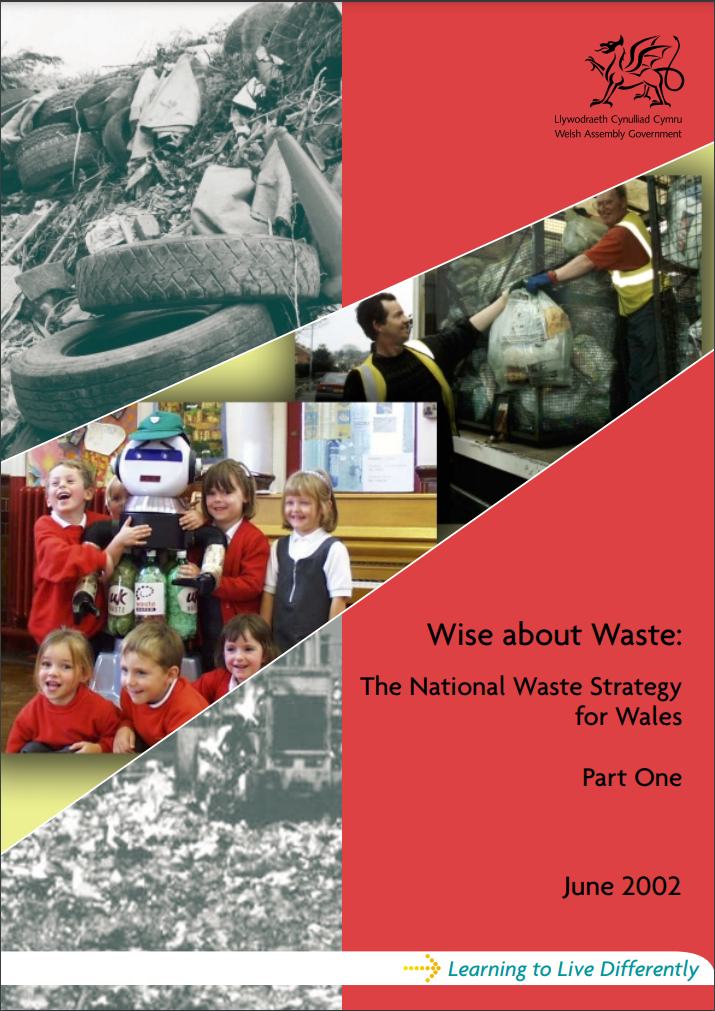
Part 1 of this extended blog post covered the rise of recycling from the late 1970’s through to the 1999 devolution of responsibility for waste management to the Welsh Assembly Government and the June 2002 publication of the first national waste strategy for Wales.
Part 2 picks up the thread from 2005 continuing up to the publication of ‘Beyond Recycling’ the Circular Economy Strategy for Wales in March 2021.
Funding and food waste – a circular success in the making
In 2005 the Environment, Planning and Countryside Committee of the National Assembly for Wales carried out an inquiry into “progress in meeting recycling and landfill diversion targets”. The report on the results of this consultation offered 25 recommendations, including several pertaining to the need for funding to support recycling and composting.
In the words of the Committee: “The Committee acknowledges the significant funding that the Welsh Assembly Government has provided to local authorities and that this has been a major factor in securing higher levels of recycling and composting. The Committee considers that meeting the targets for 2009–10 and beyond will require substantial capital and operational funding, and at significantly higher levels than currently provided”.
In addition to various sources of funding for local authorities (such as the Revenue Support Grants, Council Taxes, Specific Sustainable Waste Management Grants, and Performance Incentive Grants), the report provided examples of other funding:

As we move to 2007 and beyond we see separate food waste collections being rolled out across much of Wales. This has been described as ‘pivotal’ in improving recycling rates in Wales.
On Friday 12th October 2007 the BBC News reported on how “the lion’s share of a £14m grant package in Wales” had been “awarded to seven local authorities for food, kitchen and green waste schemes”, to support what the BBC article described as “food waste recycling”. And in November 2007 WalesOnline published an account of how weekly collections of food waste were to be trialled ahead of a roll-out across Cardiff, and how such weekly collections could greatly reduce the use of landfill.
According to a Cardiff Council Environmental Scrutiny Committee report their 2007 inquiry into food waste collections found that: “the most important aspect to gain public support was talking face to face with the public, through door to door calling and having road shows at schools and community centres”.

The report also noted how:
successful implementation was dependant on…appropriate and extensive education and support to the public to assist with the implementation of food waste collections and ensure the public are aware of the reasoning behind the changes…[and how] to ensure public support the Council will need to deliver on their promises. An important factor in this is the attitude of the workforce. Collection crews need to be fully aware of the reasoning behind introducing food waste collections…
Mal Williams identified separate food waste collections as an important ‘success factor’ in the increasing of recycling rates, observing how the success of the separate food waste collections gave the Welsh Assembly Government (and the then Minister for Environment, Sustainability in the Welsh Government – Jane Davidson) greater confidence to encourage change.
Meanwhile, efforts to promote recycling across Europe were continuing, and in November 2008 a revised Waste Framework Directive (WFD), also known as Directive 2008/98/EC of the European Parliament and of the Council, was adopted. According to the WFD’s Preamble (Section 28), the aim of the WFD was to lay the basis for turning the European Union into “a ‘recycling society’ seeking to avoid waste generation and to use waste as a resource”.
One of the features of the WFD is the European Waste Hierarchy

Think of the children, the grandchildren, and the planet
With the publication in May 2009 of ‘One Wales: One Planet’, the 2009 Sustainable Development Scheme, the Welsh Assembly Government “made a commendable start to tackling [Wales’] ecological and carbon footprints…”
The WWF Cymru report from 2011, entitled ‘Delivering a One Planet Wales: Is the Welsh Government delivering a One Planet, low carbon Wales?’, goes on to describe the Scheme as providing: “a clear and measurable overall vision that the people of Wales, within a generation will live sustainably, using only our fair share of the planet’s resources” noting the Scheme’s commitments “to reducing carbon-based energy use by 80-90% over the same period, moving towards zero waste, less car travel and more sustainable food, within a fairer society“.
One Wales: One Planet committed the Welsh Assembly Government to embrace sustainable development as the central organising principle and the “overarching strategic aim of all policies and programmes across all Ministerial portfolios” that “sets out a vision of a sustainable Wales, based on using only a fair share of the earth’s resources and becoming a fairer and more just nation”.
The introductory chapter begins with a quote from then First Minister Rhodri Morgan:

The 78-page document uses the words ‘waste’ or ‘resource’ 127 times, helping to emphasise the importance given to sustainable resource use. This is made clear by statements such as: “…we will need to reduce by at least two thirds the total resources we currently use to sustain our lifestyles. To reduce this we must…have a radically different approach to waste management, moving towards becoming a zero waste nation. By this, we mean a society where we focus on eliminating waste, and waste that can’t be eliminated must be recycled in ‘closed loop’ systems that achieve the best reduction in ecological and carbon footprints…”
One Wales: One Planet also states that:
By 2050, we want to see zero waste, so products and services will need to be designed so that they reduce or reuse waste as far as possible”, noting how “Recycling alone will not get us to where we need to be by 2025 if we are to be a zero waste nation by 2050. Our new waste strategy will therefore stress that prevention of waste is our most preferred option…
By February 2010 three important developments helped progressed this vision, the publication of ‘The Sustainable Development Annual Report 2008-2009’, the adoption of The National Assembly for Wales (Legislative Competence) (Environment) Order, and the proposal for a series of ‘waste measures’ designed “to ensure that municipal waste in Wales is managed in a way that delivers the most beneficial environmental outcomes”.
The Sustainable Development Annual Report 2008-2009 restates the vision for sustainable resource use to include the aspiration that “…local people are involved to promote low-carbon, low-waste living as part of a One Planet Nation…”
Achievements celebrated in the Report include:
- The provision of £50 million in Sustainable Waste Management Grant support for local authorities to meet Welsh Assembly Government and EU Directive waste management targets.
- The continuing decrease in municipal waste, a trend that started in 2005/06.
- Preparation of the draft new Waste Strategy “Towards Zero Waste” in co-operation with partners, which was launched for consultation in April 2009. “Towards Zero Waste sets out an ambitious agenda for change and incorporates our commitments within the Environment Strategy “to minimise the amount of waste we produce at source and work towards achieving minimised waste to landfill by 2026”.
- Meeting municipal waste targets with the recycling and composting rate at 36% and all Welsh local authorities meeting their Landfill Allowance targets, and the statutory EU Landfill Directive landfill allowances targets for 2009/10.
- The launch of what is described as “a major long term waste treatment investment programme to ensure the adequate availability capacity for local authorities to ensure Wales meets its EU diversion targets and aligns with the emerging Waste Strategy document”. Two strands of the programme were ‘mobilised’ during the period covered by the Report, including: food waste treatment and residual waste treatment – with food waste treatment credited for “contributing largely to the achievement of 2012/13 EU targets”.
- Total waste arisings having fallen 5.4% against the baseline.
- 59% of office waste having been sent for recycling.
These achievements were accomplished in the very early days of the One Wales: One Planet Sustainable Development Scheme, and they help to reinforce the centrality of resource management in the Welsh approach to sustainability. The provision of funding and the collection and treatment of food waste continue to be recognised as important to the fulfilment of Wales’ forward-looking vision of local and global sustainability.

The adoption of The National Assembly for Wales (Legislative Competence) (Environment) Order 2010 “conferred the National Assembly for Wales with legislative competence to make primary legislation (known as Assembly ‘Measures’) in respect of waste”.
The proposed Waste (Wales) Measure 2010 was laid before the National Assembly for Wales on 22 February 2010. The Measure, which was adopted in December 2010, “makes provision to reduce the amount of waste and litter in Wales whilst also providing a more effective system of waste management”.
The Measure:
- Set statutory recycling targets.
- Established charges for single use carrier bags (specifying how funds raised must be spent on preventing or reducing waste, waste management, protecting or improving the environment in relation to pollution or nuisances, and associated educational or recreational activities for children or young people).
- Allowed for the adoption of future regulations prohibiting incineration of waste [“The Welsh Ministers may by regulations make provision for and in connection with prohibiting or otherwise regulating the incineration in Wales of specified kinds of waste”].
The Regulatory Impact Assessment of the Measure’s waste target provisions describe the targets’ “Purpose and Intended Effect” as well as spelling out the “Rationale for Government Intervention” as follows:


And, to make absolutely clear that such environmental improvements would benefit future generations, the Well-being of Future Generations (Wales) Act 2015 was enacted in April 2015. The Act provides a legally-binding requirement for public bodies to: “take account of the long-term, help to prevent problems occurring or getting worse, take an integrated and collaborative approach”, and consider and involve people of all ages.
The Act also established the role of the Future Generations Commissioner for Wales “to promote the sustainable development principle (the five ways of working), in particular to act as a guardian of the ability of future generations to meet their needs, and encourage public bodies to take greater account of the long-term impact of the things that they do”.

For more about the well-being goals for Wales visit the Welsh Government’s The Well-being of Future Generations webpage and to read about the Future Generations Commissioner for Wales see the guidance on how the law is used “to improve social, economic, environmental and cultural well-being”.
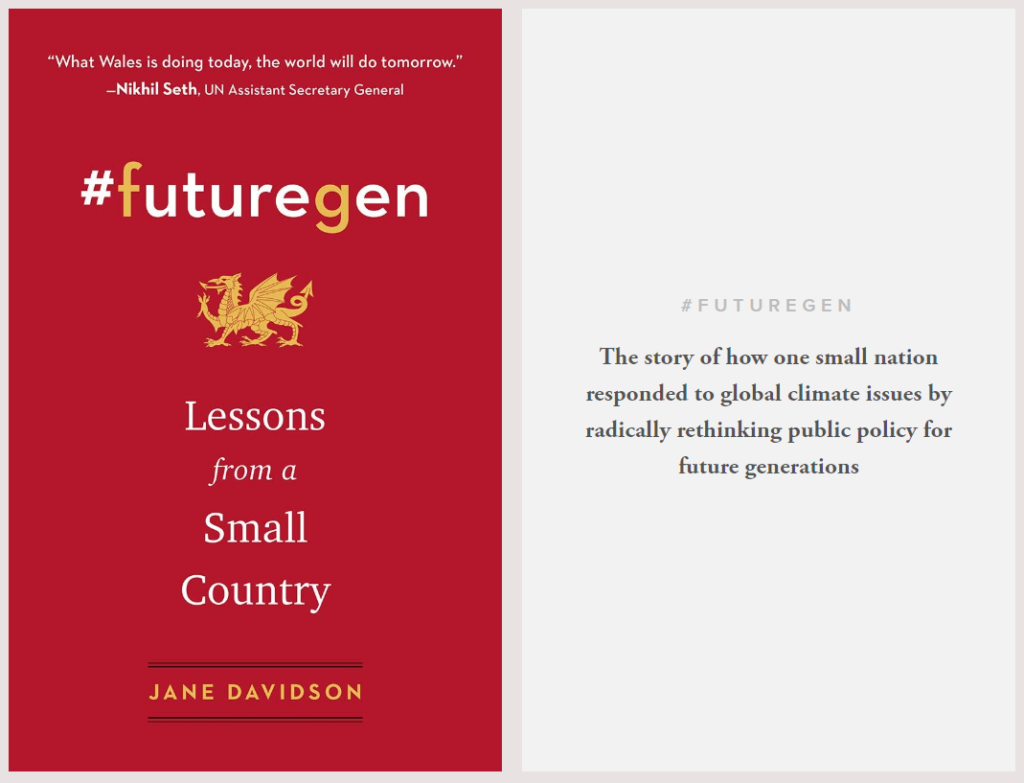
Jane Davidson was the Welsh Government Minister for Environment, Sustainability and Housing who first proposed what became the Well-being of Future Generations (Wales) Act 2015. For a comprehensive account of the introduction of what has been described as “the first piece of legislation in history to place regenerative and sustainable practice at the heart of government” you can read Jane Davidson’s book entitled “#futuregen“.
Part of the significance of the Act for resource and waste management is the Act’s promotion of long-term thinking capable of disrupting the tendency to put the demands of electoral cycles ahead of what is required for sustainability.
Such a profound cultural shift is highlighted by Jane Davidson, including in the following passage from page 111 of her book:
The addition of ‘culture’ to the usual three domains (environment, society and economy) is an important contribution that I would recommend to any country deciding to go down this route and one that we first added into ‘One Wales, One Planet’. This is because I believed then and now that changing ‘culture’ (including…organisational culture) is the most powerful tool to create the marriage between evidence and empathy needed to enable the delivery of a future generations framework…It is critically important in particular that the Act is not seen to be in the ‘culture’ of any one political party but is a tool for the people of Wales to hold their government and public services to account by calling for a change to the current consumerist, wasteful, throw-away society.
Support for collaborative change
Decisions were made to support these policies with the guidance and funding necessary to achieve the various goals, targets, and commitments described above. Instead of leaving matters to the vagaries of ‘market forces’, organisations such as WRAP Cymru are actively involved in promoting systemic change.
Under the heading “Tackling the entire system” WRAP Cymru explains how: “Tackling a single part of an issue can just move the problem elsewhere. We take a holistic approach, consider the whole system and create solutions that work together”.
A practical example of this systemic approach is WRAP Cymru’s Market Development Programme, which is designed “to increase both the supply of, and demand for, products containing recycled content in Wales”, though supporting the use of recycled material in manufacturing via a Circular Economy Fund and a range of supply chain projects offering technical support. WRAP Cymru is also working with the public sector to increase the procurement of sustainable goods.
At the heart of these efforts is WRAP Cymru’s Collaborative Change Programme (CCP), which offers “strategic, technical and communications support to help local authorities develop and deliver detailed plans to achieve the outcomes of Welsh Government’s national waste strategy, Beyond recycling”. And at the heart of the CCP is Russell Owens, who has been described as “The unsung hero of Wales’ recycling success!”
Wales remains ahead of the pack
In April 2017 the House of Commons Environment, Food and Rural Affairs Committee (EFRACOM) published a report on Food waste in England.
The EFRACOM report recommended “that there should be a national food waste target. An ambitious, formal target on food waste would influence the Government’s approach to food waste, ensuring that there continues to be a focus on reducing food waste“.
The report included the following graph which acknowledges how the devolved nations provided a higher proportion of households with food waste collections, with Wales having exceeded 90% by 2012. This figure grew to 99% by March 2020.

Indeed, according to official UK waste statistics, Wales has remained ahead of the pack for more than a decade.

As can be seen from the chart and image below, most Welsh Local Authorities continued to improve their recycling rates throughout 2022 and into 2023, reaching around 66% recycling.


Going beyond recycling – making it real
For more than two decades Wales continued to make progress with recycling and composting, and with diverting waste from both landfill and incineration. These efforts were celebrated with the publication in March 2021 of ‘Beyond Recycling’ the Circular Economy Strategy for Wales.
Described as “A strategy to make the circular economy in Wales a reality”, the publication was accompanied by the release of a 7-page ‘Easy read version’ which includes the following:

The publication of Beyond Recycling was also accompanied by “an immediate moratorium [halt] on any future large scale energy from waste [incinerator] developments”.
As Lesley Griffiths explains in her Minister for Environment, Energy and Rural Affairs’ 24th March 2021 Written Statement ‘Taking action to make the circular economy a reality’:
…this moratorium…recognises the views we received from citizens and stakeholders during the consultation on Beyond Recycling and the advice from the UK Committee on Climate Change on the pathway needed for Wales to decarbonise. This will be accompanied by the publishing of an updated strategic assessment which shows…the success of our recycling and the decrease in waste generated in Wales means no further large scale energy from waste plants [i.e. those capable of generating 10MW or greater] are required.
The Written Statement goes on to specify that: “Any new small scale [incineration] facilities must also supply heat, and where feasible, be carbon capture and storage enabled or ready. This will therefore mean a small scale plant would not be allowable if waste is to be imported from outside of the proposed region…in order to also avoid locking in transport emissions and associated pollution. This moratorium is being given effect through the planning system. Planning Policy Wales states that the extent to which a proposal demonstrates a contribution to waste management objectives, policy, targets and assessments contained in national waste policy will be a material consideration”.
And on page 26 of the full Beyond Recycling strategy document we read how:
In order to go beyond recycling, we want to develop the infrastructure to accelerate the growth in re-use, repair and remanufacturing and support an expansion in hiring, leasing and lending. We will also need to ensure the infrastructure we have is decarbonised and future investment supports the wider transition to a low carbon economy. We will work with key partners as part of our Team Wales approach to achieving a net zero public sector by 2030.
“As repair, re-use and recycling continue to expand, we want to ensure the capacity we have for generating energy from waste is in line with the capacity needed during our transition to a circular economy, with the long-term solution being to move away from incineration. We also want to see our towns across Wales demonstrate circular approaches by having repair and re-use hubs as well as other important infrastructure including refill points, zero waste shops and resilient green infrastructure.
Wales’ role as trailblazer and exemplar is confirmed by the actions of the Scottish Government, who followed suit with their own incinerator moratorium in 2022 following a temporary pause announced in November 2021.
And in breaking news, following extensive lobbying by members of communities across England, the UK Government appears to be taking some steps that could result in a moratorium on new waste incineration capacity in England, as all environmental permits for new incinerators have been put on hold as of 4th April 2024 to, in Sir Mark Spencer’s words: “…allow a short period for Defra officials to lead a piece of work considering the role of waste incineration in the management of residual wastes in England”, impacting on dozens of incinerators with a cumulative total of millions of tonnes of capacity, including those that have secured planning permission but that have yet to secure an environmental permit.
As has been acknowledged many times by many people involved with Wales’s journey towards zero waste and a more circular economy, the community has been central to the Welsh circular success story. It is demonstrably true that community-based organisations and groups of circular citizens were pivotal when it came to bringing about, and ensuring the enforcement of, the moratorium on new waste incineration capacity in Wales.
Beyond this pair of blog posts, the Circularity Foundation will be identifying and exploring a range of ‘success factors’, such as community involvement, systems thinking, an emphasis on the quality of recyclates, and the provision of policy support including Government financing associated with “How Wales became a world leader in recycling”.
New: The Circularity Foundation publication considering the success factors contributing to Wales’s circular success story – Circular citizenship in Wales – is now available to download.