
This telling of the story of circular citizenship in Wales – which comes in two parts – begins in the late 1970’s and runs through the 1999 devolution of responsibility for waste management to the Welsh Assembly Government and the June 2002 publication of the first national waste strategy for Wales. Part 2 will pick up the thread from 2005 continuing up to the publication of ‘Beyond Recycling’ the Circular Economy Strategy for Wales in March 2021.
In the beginning…
Whilst resources, including discarded resources (i.e. waste), have of course been managed for many, many years, this origin story takes as its point of departure the establishment of the Community Support Anti-Waste Scheme – or CSAWS – which operated in Cardiff from around 1979 – 1989. CSAWS is credited as being the UK’s first citywide kerbside paper collection scheme for recycling.
Another pioneering initiative – this one based in Bristol – was known as ‘Resourcesaver’. Described as a ‘direct collection project’, Resourcesaver was managed by Dick Perry and Jane Stephenson and associated with Bristol / Avon Friends of the Earth. According to an April 1987 feasibility study carried out by David Mansell:

Having discussed the origins of the commitment to zero waste in Wales with Mal Williams, the Executive Director of The Zero Waste International Trust, it became clear that Mike Croxford was one of the pioneering circular citizens behind the Welsh story. Both Mal and Mike are described as having been “instrumental in driving source separation and the collection of high quality recycled materials in Wales” over the past 30 years.

Mike Croxford has been described as “a pioneer of recycling in his native Wales…[whose] interest in recycling began in 1980, while running the Augusta Street youth project in Cardiff. The young people started collecting newspapers to improve their standing among local people and to fundraise to run events for the community. The project turned into the Community Support Anti-Waste Scheme (CSAWS) that in 1986 initiated the first citywide collection scheme in the UK”.
Although there are no signs of a CSAWS website anywhere on the Internet, CSAWS is listed as having received £7,489 of funding from the Welsh Office’s 1978/79 Urban Programme, and as having been sponsored by Cardiff City Council. CSAWS was described in a doctoral thesis (entitled Waste Paper Recycling A Community Technology Approach) as an “Anti-Waste Co-operative” that employed eight people in 1981.
CSAWS is listed as an Affiliate Member of the Wales Council for Voluntary Action (WCVA) in the WCVA Annual Reports for 1986/87 and 1987/88, and reference was made to CSAWS in House of Lords as part of a debate on the re-use of waste materials that took place on 13th November 1989. Lord Hooson explained how “One hundred local businesses were involved, the local authority was involved and there was an urban aid grant from central government. Recycling took place with eventually a full-time staff of 47. There was a great deal of voluntary collection, and the activity was particularly directed at paper recovery” adding: “That shows what can be done in one town”.
Newport is another town in South Wales where the community has been active in promoting recycling since the 1980’s. According to their website, Wastesavers is both a social enterprise and a charity that currently offers “commercial recycling services in Newport, Cardiff, Monmouthshire, Torfaen and surrounding South Wales areas”. As a social enterprise Wastesavers “provides the weekly domestic recycling service for 75,000 households on behalf of Newport City Council”. The Wastesavers Charitable Trust (Charity No: 1116150), which benefits from the support of more than 120 volunteers as well as more than 40 employees, runs a network of reuse shops, two repair cafes, a Nappy Library and two education programmes.

One of these education programmes, known as ‘PEAK’, entails delivering an “alternative curriculum for young people struggling with mainstream education”. According to their 2023 Trustees Report, Wastesavers Charitable Trust “works with schools, pupil referral units, the youth offending team, social services, and local authorities in South East Wales, specifically Newport and Torfaen, to take young people who are finding it difficult in mainstream education. The young people then work towards gaining basic/essential skills including plumbing, carpentry, bike repair, cookery, photography and Art and Design”.
Wastesavers was set up in 1985 to promote the importance of reuse and recycling in Newport, with an emphasis on maintaining recyclate quality and engaging the local community. Their website describes how, in the mid 1990’s they “became more proactive and began picking up old newspapers from peoples’ doorsteps for recycling, and hand sorting these at the local paper mill”. The About section shares how: “In 1995 Wastesavers collected and recycled 22 tonnes of paper. Today Wastesavers recycles more than 18,000 tonnes of material…We now employ more than 100 people across our kerbside and commercial operations as well as our reuse and education charity work”.
For more about The Story of Newport, and how “when separate collection systems prioritise quality over just quantity, and invest heavily in meaningfully engaging with the community, combined with well-designed equipment, world-leading results can be achieved whilst simultaneously reducing costs for local residents” see the case study produced by Zero Waste Europe as part of their Zero Waste Cities initiative.
Another major breakthrough for Wales was the establishment in 1997 of Cylch (Welsh for ‘circle’), the Wales Community Recycling Network (Wales CRN), which was formed to promote sustainable resource management through education and practical action in Wales.
As their Wiser Directory entry explains, from the very beginning Cylch promoted and supported “partnership-led, community-based, sustainable resource management initiatives as the practical and effective solutions to Welsh waste problems”, whilst viewing so-called ‘waste’ materials “as valuable resources, which, if managed effectively, create environmental, social and economic benefits for individuals and the communities in which they live”.

Their website was launched in February 1999 where Cylch is described as “a non-profit-distributing, registered charity, forming the Welsh element of the Community Recycling Network UK (CRNUK)” with the following aims and objectives:
- to promote sustainable resource management through public education and practical action
- to position the community sector centrally as an equal partner in the future of resource management in Wales
- to ensure free exchange of information between member organisations
- to support new and existing waste minimisation, re-use, recycling and composting projects, enabling them to achieve financial independence through delivering high quality support services to them
Significantly, with respect to their aim of positioning the community sector centrally as an equal partner in the future of resource management in Wales, Cylch’s Chief Executive Mal Williams was appointed the community sector representative on the Wales Waste Forum. The Wales Waste Forum was established in December 2000 by the Welsh Government Minister for Environment, Transport and Planning Sue Essex to advise on the development of the Welsh waste strategy.
Such a national waste strategy for Wales was required because in 1999 responsibility for waste management was devolved to the Welsh Government.
1999 – All change
1999 was a transformative year, both for waste management and for Wales.
The Landfill Directive, more formally described as Council Directive 1999/31/EC of 26th April 1999, was a European Union directive for the regulation of waste management in landfill sites across the European Union. The Directive’s overall aim was “to prevent or reduce as far as possible negative effects on the environment, in particular the pollution of surface water, groundwater, soil and air, and on the global environment, including the greenhouse effect, as well as any resulting risk to human health, from the landfilling of waste, during the whole life-cycle of the landfill”. This legislation had important implications for the management and disposal of waste.
Less than a month later the National Assembly for Wales met for the first time (on 12th May 1999), when the Welsh Government was given a statutory duty to promote sustainable development. This proved to be a turning point for waste and resource management in Wales.
In a press release, entitled ‘How Wales became a world leader in recycling’, issued by the Welsh Government in March 2020, we read how: “The Welsh Government is working to make Wales a greener, more equal, and more prosperous country. How we manage our waste and the resources we use has become even more crucial; in the growing fight to tackle climate change. Since Wales has had its own government in 1999, we have become a global leader in recycling. We’re now first in the UK, second in Europe and third in the world for household waste recycling. Put simply, recycling is what we do! This achievement has taken a clear, long term vision, strong partnership working, significant investment and clear milestones along the way”.
1999 also saw the publication in July of a visionary book by Robin Murray entitled ‘Creating wealth from waste’. Both the book and Robin Murray’s own active involvement proved inspirational to the UK’s emerging zero waste movement. Robin had already been working with others, including Nicky Gavron who was made Deputy Mayor of London in 2000, on an alternative Alternative Waste Strategy for London which had been published as ‘Re-Inventing Waste: Towards a London Waste Strategy’ in August 1998. Robin went on to write ‘Zero Waste’ which was published by the Greenpeace Environmental Trust in February 2002.
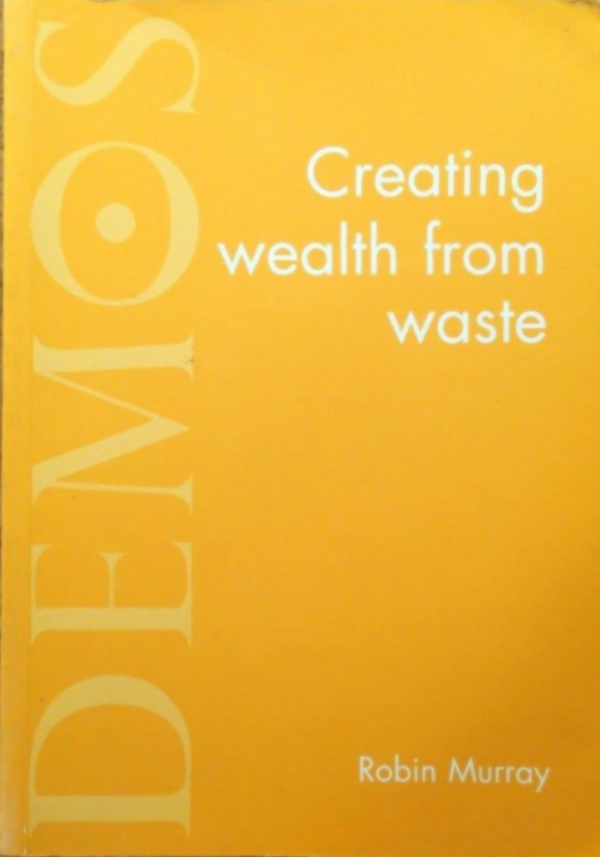
In ‘Creating wealth from waste’ Robin Murray set out how waste management was becoming “a dynamic, fast-changing, international economic sector” and how “This transformation presents new choices and opportunities, and provides lessons and pointers for industrial, social and environmental policy” driven by growing concern about the hazards of waste disposal, broader environmental concerns, especially global warming and resource depletion, alongside “the economic opportunities created by new waste regulations [such as the Landfill Directive] and technological innovation”.
Prophetically, Robin warned how: “…Multinationals are taking an increasing interest in waste. Privatisation has opened up new markets in collection. The new standards of treatment and the industrialisation of waste management require resources beyond the means of small and medium-sized firms…the environmental movement has created a new economic interest in waste and recycling. This interest, combined with the opportunities created by technological innovation, is extending down through the supply chain” noting that: “Intensive recycling and waste reduction depends on changing whole systems. It relies on distributed intelligence rather than centralised knowledge and on innovation that is widely dispersed across collection, processing, materials technology and product design. As a result, the change can seem far harder to achieve than the straightforward modernisation of existing systems”.
“Zero waste” is one term used to describe the profound systemic change required to meet the combined challenges posed by the increasing commercialisation (or ‘industrialisation’) of waste management (previously led by the public sector) and the environmental imperatives of addressing climate change and resource depletion.
The zero waste community leads the way
Cylch’s dedication to promoting “sustainable resource management through public education and practical action” found practical expression in the approach to “Total Resource Recovery” known as Cleanstream® which was first introduced in March 2000. This constituted a profound community contribution to the emerging national waste strategy for Wales.
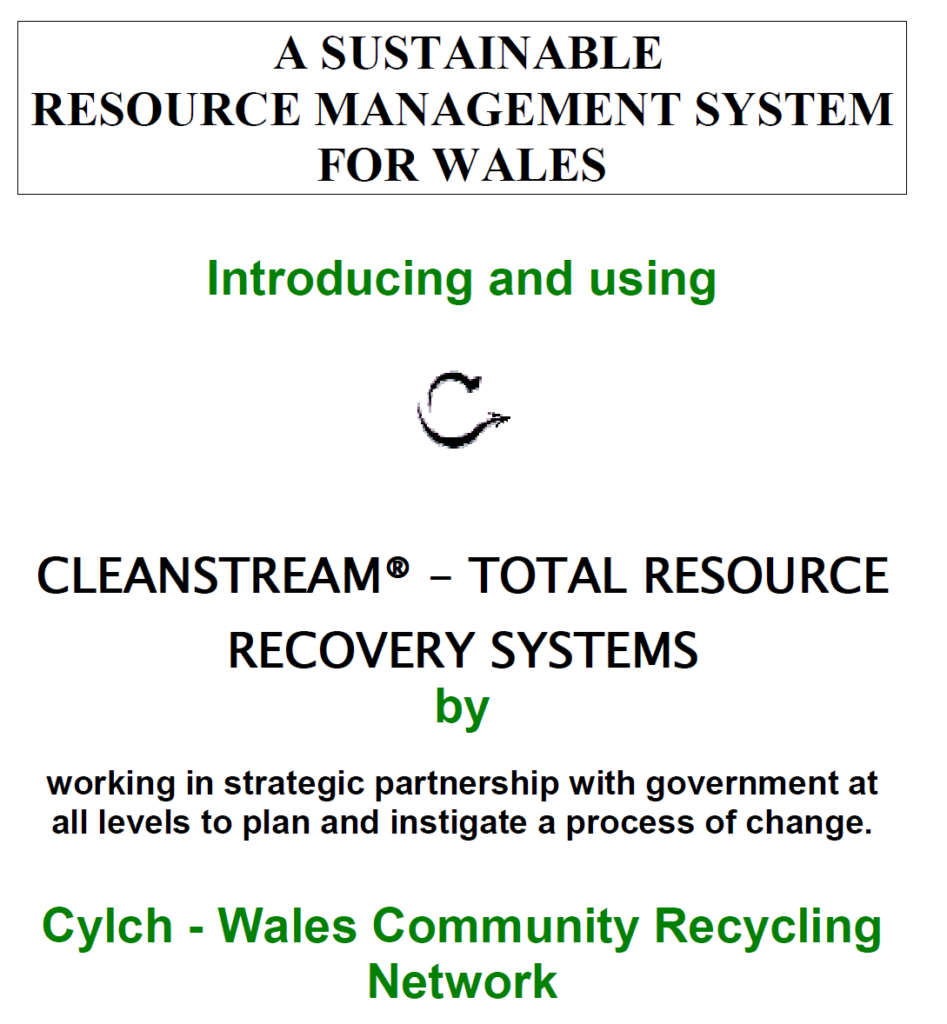
In Cylch’s own words: “Cylch’s Community Waste Strategy is based on working in partnership with government at a national, regional and local level to achieve a Sustainable Resource Management Strategy and Implementation Plan that will reduce waste. To meet and exceed the targets set by the current legislation in the Landfill Directive and the forthcoming UK Waste Strategy. Cleanstream® is a quality standard but this document incorporates it into a PROCESS of managing change”.
Cylch declared that “if we separate used materials in the first place, we have an opportunity”. Described as “the vehicle that creates and develops this opportunity” Cleanstream® was designed to set a standard and describe a process “to achieve radical change in the way we manage resources after first use” intended to show how Wales could “utilise its new found political independence and Objective 1 status in order to reap the tremendous benefits of changing to this very Sustainable Resource Management System“.
The thinking that underpinned the Cleanstream® Total Resource Recovery System proposed for Wales also influenced zero waste activists around the world. In 2002 what became known as The First Zero Waste Dialog was held in Brighton. According to the Zero Waste International Alliance (ZWIA), in February 2002 “activists, most of them part of the ZWIA team as well as experts from several other organizations, held a meeting chaired by Professor Robin Murray, teacher at the London School of Economics and author of two books on Zero Waste (Zero Waste and Creating Wealth From Waste). Together the team helped to form a Zero Waste coalition for the UK, and also set the wheels in motion for formation of the Zero Waste International Alliance (ZWIA). This meeting was what the ZWIA team later retrospectively called the first Zero Waste dialog”.
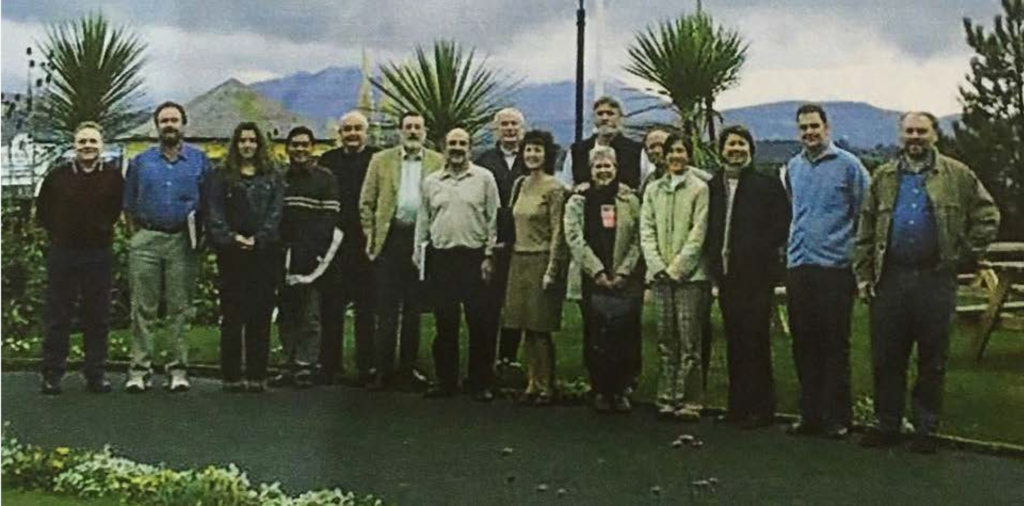
which took place in Wales in October 2003
Thanks to Mal Williams for providing a copy of this photograph
From left to right: Warren Snow (Zero Waste New Zealand Trust), Eric Lombardi (Eco-Cycle), Monica Wilson (GAIA), Manny Calonzo (GAIA, The EcoWaste Coalition), Mal Williams (Cylch), Richard (Ric) Anthony (Grass Roots Recycling Association), Mike Underwood (Cylch and Biognosis), Robert Slater (Environment Canada), Julie Dickinson (Zero Waste New Zealand Trust), Gerry Gillespie (Zero Waste Australia), Carolyn Brooks (Zero Waste Australia), George Cheng (Waste Not Asia), Chia-Jung Lee (Taiwan Watch Institute), Sonia Mendoza (Mother Earth Foundation), Jim McLaughlin (Community Resource Network), and Andy Moore (Community Resource Network)
Those wheels continued to turn, and from 19th – 21st October 2003 a series of meetings were held at the Bulkeley Hotel in Beaumaris, Ynys Môn, Wales resulting in the formation of the Zero Waste International Alliance with the following initial focus:
- To convert waste to resources for the benefits of local production and the creation of a sustainable society.
- To redesign products and methods of production to eliminate waste by mimicking natural processes and close loops.
- To resist incineration and landfilling in order to promote innovation in resource conservation and methods of production.
- To collaborate with others with common interests worldwide, to advance the education of the public by all appropriate means through the elimination of waste.
- To promote and fund scientific research for the public benefit.
- To promote the effectiveness of other (zero waste) charities.
- To promote recycling through sustainable resource management in accordance with best practice.
These meetings were informed and energised by the paradigm-shifting genius that inspired the Cleanstream® approach, and the whole event was funded using earnings from Cylch’s work supporting the development of a zero waste strategy for Doncaster.
According to ‘An opportunity not to be wasted: Doncaster Waste Strategy 2009’: “The [Doncaster] Mayor’s Zero Waste Strategy was developed by DMBC [Doncaster Metropolitan Borough Council] in 2004; the process involved a significant amount of public consultation and engagement with different stakeholder groups. The approach was significantly wider than just municipal waste and aimed at combining resource efficiency actions with those for economic development and employment in Doncaster”.
Returning to Wales, and returning to June 2002, the first national waste strategy for Wales was published. ‘Wise About Waste’ opened with the following paragraph: “Waste is Wales’ biggest environmental problem; a problem to which we all contribute as individuals on a daily basis. However we can also as individuals be part of the solution. This new waste strategy for Wales, Wise about Waste, sets the direction for developing sustainable waste management practices in Wales, in some cases building on the good work that is already taking place and in others developing whole new solutions. This new strategy replaces the joint England and Wales Waste Strategy 2000 and represents the National Assembly for Wales and the Welsh Assembly Government taking formal responsibility for waste matters within Wales“.
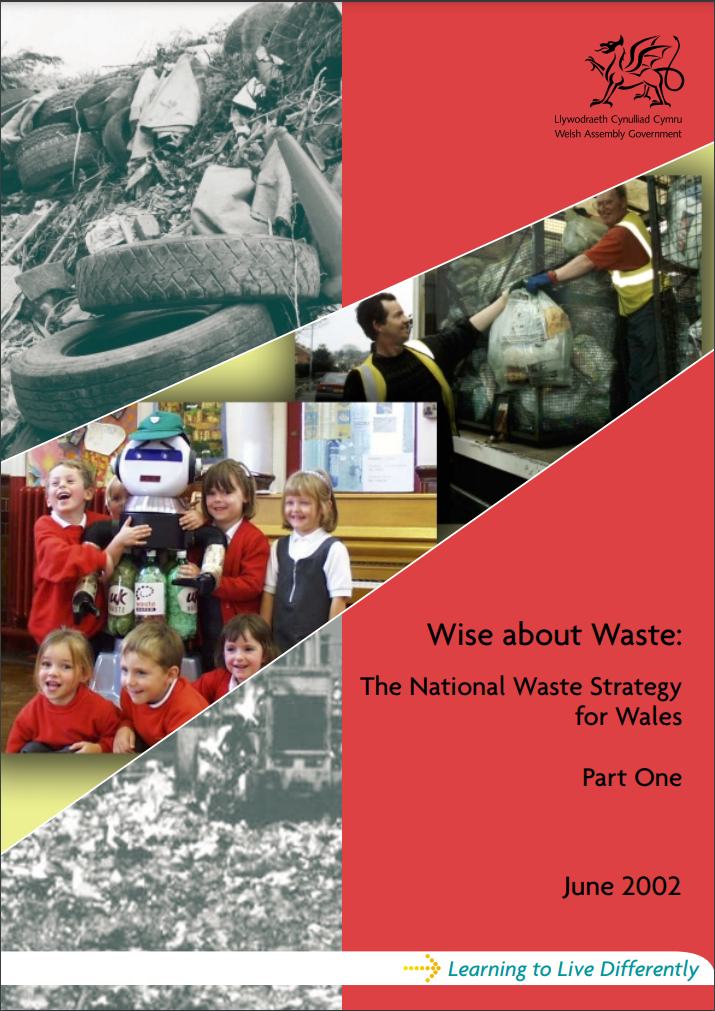
Wise about Waste went on (at paragraph 5.39) to spell out how: “Local authorities are encouraged to enter into partnerships with the community sector and the waste industry to deliver an integrated system that maximises the separate kerbside collection of recyclable and compostable material and the further extraction of materials from residual wastes. This three-way partnership can take maximum advantage of the strengths of each sector. In particular, local authorities are encouraged strongly to involve the community recycling sector, since it:
- has a proven track record for kerbside collection schemes for recyclables;
- can make an important contribution towards re-use (e.g. of furniture) which counts towards the Best Value Performance Indicator for recycling;
- can provide support for disadvantaged people (thus maximising the wider social benefits of the strategy);
- is able to energise and engage communities;
- is likely to increase motivation of householders to participate in kerbside collection schemes if they perceive that charitable causes are benefiting;
- has a proven track record for community composting of green wastes;
- has a proven track record for education initiatives”.
And in the following paragraphs the strategy is even more explicit and focussed in the recommendations and offers of support, stating that: “Local authorities are strongly encouraged to follow the principles of the Cleanstream® approach advocated by the Wales Community Recycling Network/Cylch. This sets a standard for a ‘total resource recovery system’ that maximises the collection of clean recyclable and compostable materials from the household waste stream” and announcing how: “The New Opportunities Fund is committing, by 2004, £3.25m to projects that expand community sector waste, re-use, recycling and composting…”

Wise about Waste was many things, including: the first waste strategy for Wales; an expression of the National Assembly for Wales and the Welsh Assembly Government taking formal responsibility for waste matters within Wales; a pitch to individuals to be “part of the solution”; a set of recycling targets to which Wales’ various local authorities were expected to work; and a radical shift away from ‘waste management’ and towards ‘resource management’. Importantly in the context of this exploration, Wise about Waste was a very public, ‘high profile’, affirmation of how the zero waste community led the way in establishing principles that made their way to the core of the approach to be applied across the nation of Wales!
As you can see, when it comes to circular citizenship in Wales, there is much to celebrate and plenty to learn. Pioneering community-led initiatives coupled with respectful recognition and collaborative efforts on the part of local and national government in Wales has the power to inspire and to inform.
This first half of the story provides essential background information that – together with Part 2 – will help us appreciate both the community’s formative contribution to a more circular Wales, and Wales’s ongoing contribution to global efforts to improve recycling rates and move beyond recycling to a more circular, zero waste, economy.